Skip to Main Content
 Equal Housing Lender. © 2026 M&T Bank and its affiliates and subsidiaries. NMLS #381076. M&T Bank Member FDIC.
Wilmington Trust is a registered service mark used in connection with various fiduciary and non-fiduciary services offered by certain subsidiaries of M&T Bank Corporation including, but not limited to, Manufacturers & Traders Trust Company (M&T Bank), Wilmington Trust Company (WTC) operating in Delaware only, Wilmington Trust, N.A. (WTNA), Wilmington Trust Investment Advisors, Inc. (WTIA), Wilmington Funds Management Corporation (WFMC), Wilmington Trust Asset Management, LLC (WTAM), and Wilmington Trust Investment Management, LLC (WTIM). Such services include trustee, custodial, agency, investment management, and other services. International corporate and institutional services are offered through M&T Bank Corporation’s international subsidiaries. Loans, credit cards, retail and business deposits, and other business and personal banking services and products are offered by M&T Bank. Member, FDIC. 
M&T Bank Corporation’s European subsidiaries (Wilmington Trust (UK) Limited, Wilmington Trust (London) Limited, Wilmington Trust SP Services (London) Limited, Wilmington Trust SP Services (Dublin) Limited, Wilmington Trust SP Services (Frankfurt) GmbH and Wilmington Trust SAS) provide international corporate and institutional services.
WTIA, WFMC, WTAM, and WTIM are investment advisors registered with the U.S. Securities and Exchange Commission (SEC). Registration with the SEC does not imply any level of skill or training. Additional Information about WTIA, WFMC, WTAM, and WTIM is also available on the SEC's website at adviserinfo.sec.gov. 
Private Banking is the marketing name for an offering of M&T Bank deposit and loan products and services. Custom credit advisors are M&T Bank employees. Loans, retail and business deposits, and other personal and business banking services and products are offered by M&T Bank.
Investment and Insurance Products  • Are NOT Deposits • Are NOT FDIC Insured • Are NOT Insured By Any Federal Government Agency • Have NO Bank Guarantee • May Go Down In Value  
Investing involves risks and you may incur a profit or a loss. Past performance cannot guarantee future results. This material is provided for informational purposes only and is not intended as an offer or solicitation for the sale of any security or service. It is not designed or intended to provide financial, tax, legal, accounting, or other professional advice since such advice always requires consideration of individual circumstances. There is no assurance that any investment, financial or estate planning strategy will be successful.
About Us
Wealth Management
Insights

TL;DR[1] Version

  • One year after tariffs were put in place the traditional U.S. domestic manufacturing industry is recovering in terms of orders and production, but is pulling back on building new capacity due to higher costs and uncertainty of future policies.
  • The tariffs have sharply curtailed imports of manufactured consumer goods and intermediate inputs from major trading partners such as China, the EU, Canada, and Mexico.
  • At the same time the surge in demand for AI infrastructure and the exclusion of AI-related components from tariffs are driving massive import growth from Taiwan, South Korea, and Singapore.
  • The CHIPS Act (2022) and new trade deals will increase domestic manufacturing of AI-related components over the longer-term, contributing to a turn to “smart manufacturing” in the U.S.

Full Version

Introduction

One year after the dramatic escalation of tariffs on imports from virtually all U.S. trading partners, the impacts have been profound. The Trump Administration levied the tariffs in the effort to curtail imports (especially from countries with whom the U.S. runs a trade deficit), to entice multinational firms to increase their domestic production capacity, and to gain leverage in new trade negotiations.

In these early stages the bulk of the domestic manufacturing sector has pulled back on building new capacity instead of reshoring. The sector was weakened in 2025 with contracting orders and activity, but has bounced back with solid orders in early 2026. Despite the turnaround in orders, the sector does not show evidence of reshoring. It is moving the other direction, cutting jobs and pulling back on spending for new facilities. We attribute the weakness to firms adjusting to a dramatically changed cost structure as well as the uncertainty of future tariffs, other future policies, and uncertainty of future sales.

At the same time, the seeming inexorable rise of the Artificial Intelligence (AI) industry has had at least as large of an impact on U.S. imports as the tariff policies. The hardware needed for AI is largely imported from abroad and has been mostly exempted from tariffs. Imports of semiconductor chips and other equipment have surged and are a key reason that the U.S. trade deficit widened in 2025, despite the tariff policy.

In our 2026 Capital Markets Forecast (CMF) we devoted one of the three themes to this effort to  “reshore” manufacturing activity and jobs. We concluded the policies could increase domestic manufacturing production but were less likely to generate jobs due to high labor costs. High labor costs would entice firms to make use of emerging technologies, including Artificial Intelligence (AI) and “smart manufacturing” techniques. The Trump Administration’s trade deals, concessions by individual firms, and the activity that was already underway from the CHIPS Act (2022) are likely to increase domestic supply of advanced technology products and fuel the growth of smart manufacturing.

Manufacturing construction down, data centers up

The first place to look for evidence of reshoring is construction spending on manufacturing facilities. The evidence thus far is a dramatic pullback as the industry has grappled with the challenges of higher tariffs and uncertainty. In the meantime, the strength of the AI boom has buttressed what would otherwise be an all-out decline in economy-wide construction spending.

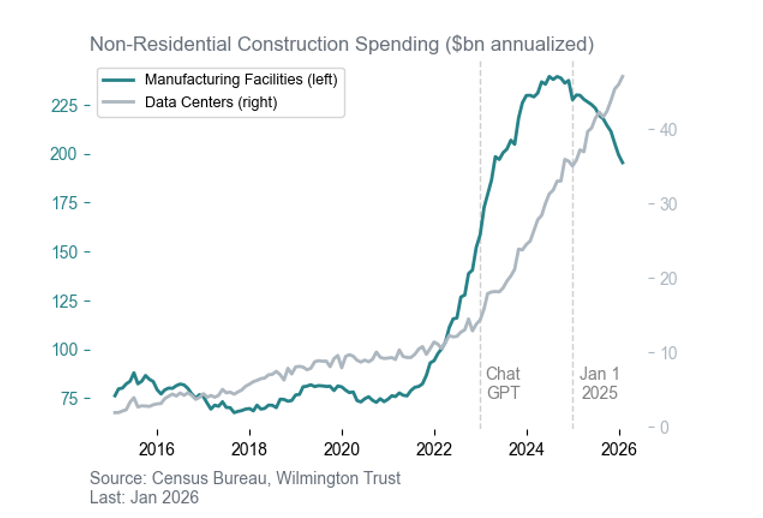
Construction spending on manufacturing facilities peaked in 2024 (Figure 1). From January 2025 to the most recent data in January 2026, the annualized spending rate dropped by $32.1 billion, about 14%. Through surveys, many U.S. companies have expressed an aversion to long-term capital expenditures as they grapple with the cost of tariffs as well as the uncertainty.

That reluctance to spend is evident in hiring too. Jobs in the sector have been declining since hitting a 15-year peak in January 2023. From that high point to the end of 2024, jobs declined by 210,000. Since the start of the Trump Administration jobs have fallen at a slower pace, down another 102,000. In principle, declining employment alone does not indicate a declining industry, as firms could shed jobs while expanding productivity. But as with capex, survey responses point to uncertainty regarding policies as well as uncertainty regarding sales and revenues.

While the manufacturing sector is retreating, construction of data centers to support the booming AI industry has filled some of the void. After the launch of Chat GPT at the end of 2022 spending on those facilities has soared at a compounded annual rate of 44% and does not show any sign of slowing (Figure 1). The boom in AI spending has been nothing short of remarkable but has not been enough to fully replace the decline in spending on manufacturing facilities. In fact, the economy-wide decline in construction spending is even more substantial. Net of data center spending, construction spending across all other sectors has declined since January 2025 (not shown). 

Tariff policies favor AI

Tariff policies have had a stark impact on the profile of U.S. imports. Specifically, tariff policies enacted since the start of 2025 raised the import costs for most traditional manufactured final goods or inputs but only minimally impacted AI equipment. The result has been stagnation of imports from most trading partners while imports from Pacific Rim countries (excluding China) have surged.

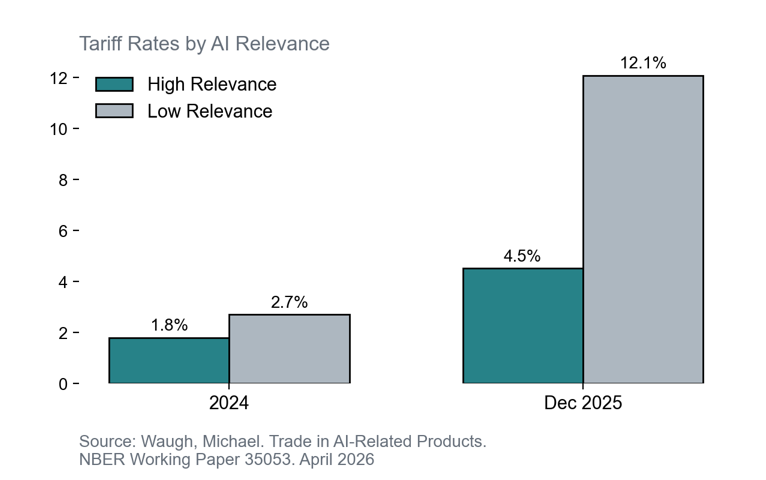
The Trump Administration was keen to curtail imports generally but did not want to impede the buildout of AI infrastructure and therefore excluded the bulk of AI-related materials.[2] Other goods received exemptions too, but semiconductors and AI equipment have been the most consistent. As a result, the effective tariff rate for items with “high relevance” to AI infrastructure rose from 1.8% in 2024 to 4.5% by December of 2025 (Figure 2). While that is more than a doubling, the effective tariff rate on imports with “low relevance” to AI rose by 4.5 times.

Figure 2: AI-related imports get a break on tariffs

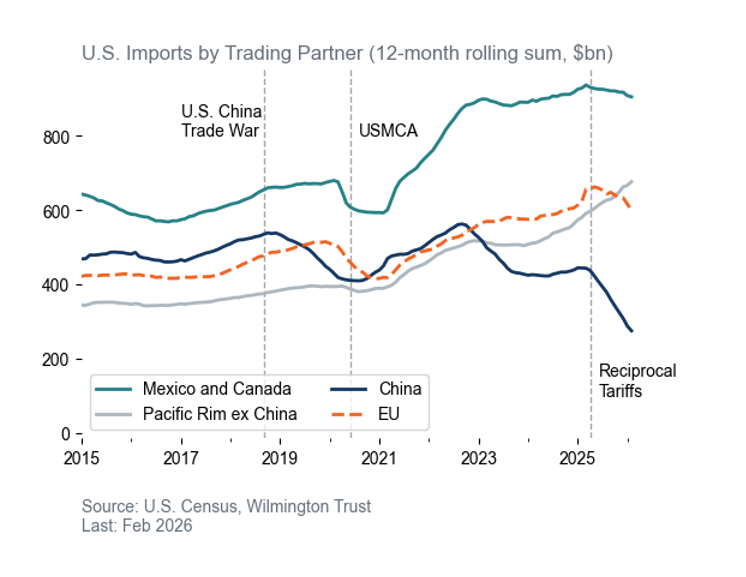
The disparity in tariffs have, not surprisingly, driven sharp changes in the profile of U.S. imports. As shown in Figure 3, imports from Mexico and Canada (autos, machinery, food, and commodities) drifted down after the imposition of new tariffs in 2025. European Union (EU) exports to the U.S. also declined over the past year. The U.S imports pharmaceuticals, autos, aircraft, and food from Europe.

China received the harshest treatment and the highest tariffs from the Trump Administration in 2025 and imports have fallen 37% since the implementation of reciprocal tariffs.[3]

The impact of AI can be seen in the continued rise and acceleration of imports from Pacific Rim countries other than China. The bulk of AI semiconductors and other high-tech equipment are imported from Taiwan and South Korea, and Singapore is a growing source for such equipment. Figure 3 shows total imports, but it is even more instructive to drill down into high-tech equipment. Imports of advanced technology products from those 3 countries by the U.S. more than doubled, from $7.6bn to $17.4bn from 2023 to 2025, illustrating the impact of the AI buildout.

Figure 3: Tariffs and the AI buildout have shifted sources of imports

CHIPS Act, Trade Deals and Frameworks

Domestic investment in AI relies heavily on imports and is likely to continue to do so in the near term, given the long-term nature of building out semiconductor chip manufacturing facilities. In the longer-term, the combined effect of the CHIPS Act[4], the Trump Administration’s trade deals, and voluntary domestic efforts by multinationals is set to boost domestic production.

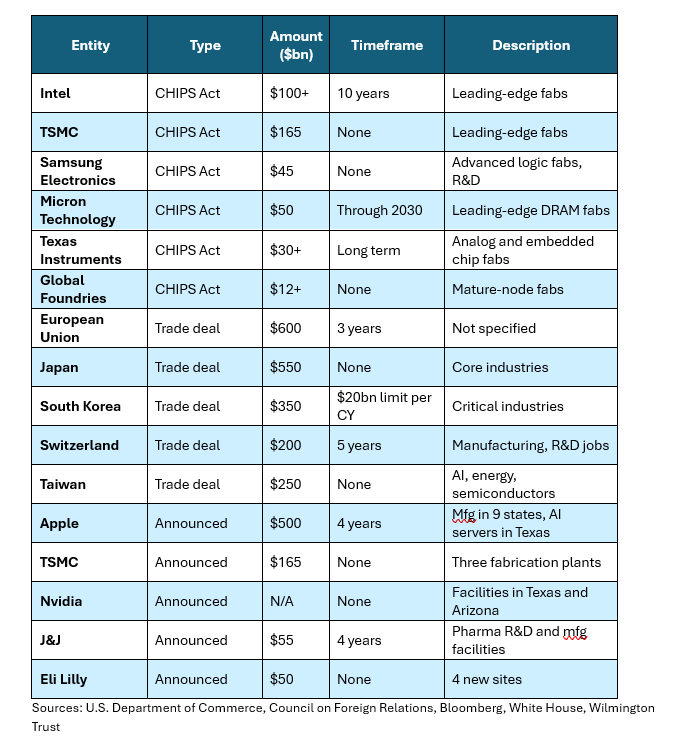
One of the Trump Administration’s main goals was to negotiate bilateral trade deals with individual countries and attract investment in U.S. domestic production. As of March 2026, roughly a year into the effort, the Administration had inked trade agreements with 9 countries and established frameworks for future agreements with 9 other countries and the European Union.[5] (Figure 4)

In terms of “reshoring” the manufacturing industry, the deals and frameworks with 12 of the trading partners include some “investment commitment” in the U.S. by the partner. Other provisions (adjustments to non-tariff barriers, labor standards, environmental standards, etc.) could level the proverbial playing field over time but are challenging to quantify.

A handful of the official trade deals contain specific language regarding direct foreign investment in the United States. Some of the deals are likely to help the domestic AI industry. The table also includes announcements made by firms that plan to make significant investments. The dollar amounts are significant. For both the trading partner agreements and the individual companies, we recognize some of the investments may have been made without the reshoring push from the administration.

Figure 4: Trading partners and companies looking to invest in the U.S.

Core Narrative

The “Reshoring Experiment” we described in our 2026 CMF is causing short-term pain for the manufacturing sector but could translate to long-term gains for the domestic AI industry. Traditional industries (autos, aircraft, machinery, metals, foods, rubber, paper, etc.) are likely to continue to struggle under the weight of tariffs, especially as new capital seeks the high returns of AI instead of domestic supply of other goods. The investments detailed in Figure 4 will take years to have an impact on domestic semiconductor production, but when realized should provide support for the AI buildout and support the turn to smart manufacturing that we expect.

We expect the development and implementation of smart manufacturing techniques to be one source of demand for AI infrastructure for years to come. We maintain a neutral allocation to equities versus our strategic benchmark. We expect leadership to remain with U.S. equities over non-U.S., benefitting from a resumption of tech leadership, strong earnings, and an economy more insulated from the effects of the Iran War.

[1] Too long; did'nt read.

[2] “Regulating Imports with a Reciprocal Tariff to Rectify Trade Practices that Contribute to Large and Persistent Annual United States Goods Trade Deficits.” Executive Order 14257. White House. April 2, 2025. And subsequent Executive Orders. 

[3] There is evidence that some exports from China have simply been rerouted (or “transshipped”) through other trading partners to avoid the higher tariffs placed on items imported from China. One study estimated $300 billion of goods annually were avoiding tariffs in this manner.

[4] The CHIPS and Science Act (August 2022) allocated $53 billion in federal incentives for domestic semiconductor research, development, and manufacturing.

[5] Council on Foreign Relations. “Tracking Trump’s Trade Deals.” As of March 17, 2026.

Disclosures

Facts and views presented in this report have not been reviewed by, and may not reflect information known to, professionals in other business areas of Wilmington Trust or M&T Bank who may provide or seek to provide financial services to entities referred to in this report. M&T Bank and Wilmington Trust have established information barriers between their various business groups. As a result, M&T Bank and Wilmington Trust do not disclose certain client relationships with, or compensation received from, such entities in their reports.

The information on Wilmington Wire has been obtained from sources believed to be reliable, but its accuracy and completeness are not guaranteed. The opinions, estimates, and projections constitute the judgment of Wilmington Trust and are subject to change without notice. This commentary is for informational purposes only and is not intended as an offer or solicitation for the sale of any financial product or service or a recommendation or determination that any investment strategy is suitable for a specific investor. Investors should seek financial advice regarding the suitability of any investment strategy based on the investor’s objectives, financial situation, and particular needs. Diversification does not ensure a profit or guarantee against a loss. There is no assurance that any investment strategy will succeed.

Past performance cannot guarantee future results. Investing involves risk and you may incur a profit or a loss.

Indexes are not available for direct investment. Investment in a security or strategy designed to replicate the performance of an index will incur expenses such as management fees and transaction costs which will reduce returns.

References to specific securities are not intended and should not be relied upon as the basis for anyone to buy, sell, or hold any security. Holdings and sector allocations may not be representative of the portfolio manager’s current or future investment and are subject to change at any time.

Reference to the company names mentioned in this blog is merely for explaining the market view and should not be construed as investment advice or investment recommendations of those companies. Third party trademarks and brands are the property of their respective owners.

Any investment products discussed in this commentary are not insured by the FDIC or any other governmental agency, are not deposits of or other obligations of or guaranteed by M&T Bank, Wilmington Trust, or any other bank or entity, and are subject to risks, including a possible loss of the principal amount invested.

Some investment products may be available only to certain “qualified investors”—that is, investors who meet certain income and/or investable assets thresholds.

Alternative assets, such as strategies that invest in hedge funds, can present greater risk and are not suitable for all investors. 

Stay Informed

Subscribe

Ideas, analysis, and perspectives to help you make your next move with confidence.

Sign Up Now

WTU Newsletter Card
WTU Newsletter Handler