Skip to Main Content
 Equal Housing Lender. © 2026 M&T Bank and its affiliates and subsidiaries. NMLS #381076. M&T Bank Member FDIC.
Wilmington Trust is a registered service mark used in connection with various fiduciary and non-fiduciary services offered by certain subsidiaries of M&T Bank Corporation including, but not limited to, Manufacturers & Traders Trust Company (M&T Bank), Wilmington Trust Company (WTC) operating in Delaware only, Wilmington Trust, N.A. (WTNA), Wilmington Trust Investment Advisors, Inc. (WTIA), Wilmington Funds Management Corporation (WFMC), Wilmington Trust Asset Management, LLC (WTAM), and Wilmington Trust Investment Management, LLC (WTIM). Such services include trustee, custodial, agency, investment management, and other services. International corporate and institutional services are offered through M&T Bank Corporation’s international subsidiaries. Loans, credit cards, retail and business deposits, and other business and personal banking services and products are offered by M&T Bank. Member, FDIC. 
M&T Bank Corporation’s European subsidiaries (Wilmington Trust (UK) Limited, Wilmington Trust (London) Limited, Wilmington Trust SP Services (London) Limited, Wilmington Trust SP Services (Dublin) Limited, Wilmington Trust SP Services (Frankfurt) GmbH and Wilmington Trust SAS) provide international corporate and institutional services.
WTIA, WFMC, WTAM, and WTIM are investment advisors registered with the U.S. Securities and Exchange Commission (SEC). Registration with the SEC does not imply any level of skill or training. Additional Information about WTIA, WFMC, WTAM, and WTIM is also available on the SEC's website at adviserinfo.sec.gov. 
Private Banking is the marketing name for an offering of M&T Bank deposit and loan products and services. Custom credit advisors are M&T Bank employees. Loans, retail and business deposits, and other personal and business banking services and products are offered by M&T Bank.
Investment and Insurance Products  • Are NOT Deposits • Are NOT FDIC Insured • Are NOT Insured By Any Federal Government Agency • Have NO Bank Guarantee • May Go Down In Value  
Investing involves risks and you may incur a profit or a loss. Past performance cannot guarantee future results. This material is provided for informational purposes only and is not intended as an offer or solicitation for the sale of any security or service. It is not designed or intended to provide financial, tax, legal, accounting, or other professional advice since such advice always requires consideration of individual circumstances. There is no assurance that any investment, financial or estate planning strategy will be successful.
About Us
Wealth Management
Insights

Global markets entered 2026 already contending with elevated uncertainty, and events over the first quarter have sharpened investor focus on two defining forces: the war in Iran and the disruptive advance of artificial intelligence (AI). We held a webinar on March 11 and discussed our view of how these developments are shaping market behavior, economic expectations, and portfolio positioning. This Wilmington Wire post summarizes and updates the views expressed during the webinar

The conflict in Iran and the resulting shutdown of the Strait of Hormuz pose meaningful risks to global commodity flows, yet we expect the economic impacts for U.S. consumers and businesses to be smaller than in previous oil‑price shocks. In the week since holding the webinar energy infrastructure has become a target. If energy infrastructure continues to be targeted we will update our expectations accordingly.

At the same time, rapid AI investment has led to sharp sector rotations, questions about earnings durability, and concerns about labor market disruption. But in our view, the longer‑term productivity potential of AI remains intact.

Ultimately, both the Iran War and the trajectory of AI are shrouded in more questions than answers. At this time, we are advising clients to stay fully invested in equities, as historically geopolitical conflicts have been more disruptive to the short-term volatility environment than the long-term economic trajectory. Within equities, we maintain full allocations to both (1) mega‑cap technology, where we believe AI‑driven disruption supports long‑term value creation, and (2) high‑quality equities, which can provide downside resilience should volatility persist. We remain defensively positioned within fixed income.

Iran and Oil Impacts

At the start of the war, we noted that the central consideration in assessing the economic impact of the Iran conflict would be the status of the Strait of Hormuz, a narrow waterway through which roughly 20% of global oil supply flows. The timing of when shipping traffic can safely resume will determine how long financial markets remain strained. The Trump administration’s objectives appear focused on two core outcomes: reopening the Strait and securing Iran’s stockpile of nuclear‑related material. Achieving those goals, even if other military ambitions remain unresolved, could mark the functional endpoint of the conflict from a market perspective.

In recent days, we have observed significant damage to Gulf State energy infrastructure, which could dramatically increase the timeline to returning to normal production capacity. In some cases production facilities and infrastructure have been shut down preemptively or with minimal damage, and returning to full production could take weeks. But in other cases, we are seeing more significant damage that could reportedly take years to rebuild. This reality, along with the possibility that any ceasefire could be tenuous and untrusted, could result in a more lasting risk premium on the price of oil.

Current State of the Conflict, Shipping Flows, and Commodity Spillovers

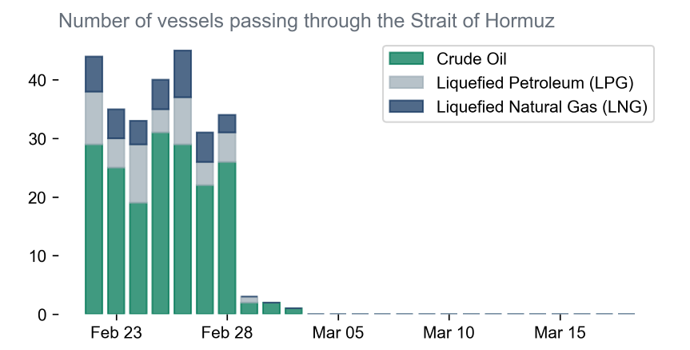
Vessel traffic through the Strait has effectively collapsed, with oil, liquified petroleum (LPG), and liquified natural gas (LNG) departures dropping from roughly 30-35 ships per day to near zero following the start of the war. Iran’s use of missiles, drones, and small, fast boats complicate U.S. and allied efforts to reopen the chokepoint, even as much of Iran’s surface navy and air force has been neutralized. Missile and drone launches by Iran have fallen sharply compared to the initial days of conflict but remain a material threat to commercial vessels.

Figure 1: Strait of Hormuz is the critical chokepoint

Sources: Bloomberg, Wilmington Trust Last: March 18, 2026.

In the early days of the war the U.S. indicated an intention to provide military escorts for commercial shippers but that has not yet occurred, and Iran’s ability to threaten such convoys remains intact. Even with such an escort, traffic through the Strait would still be a fraction of pre-war levels until the attacks are truly behind us. There is evidence of a few vessels being allowed through en route to India, reportedly as a result of negotiations between the Indian and Iranian governments. Otherwise, the Strait remains effectively closed.

Saudi Arabia and the U.A.E. may be able to reroute some oil through pipelines that sidestep the Strait, but not their full output. Crude oil futures show front‑month contracts near their highs, while long‑dated futures (late‑2026 delivery) remain anchored around the mid-to-high‑$70s per barrel for West Texas Intermediate (the U.S. benchmark) and around $85 for Brent crude (the international benchmark).1 This signals that markets anticipate a resolution within months rather than years, but it could also be a sign of complacency in markets.

Natural gas markets, particularly European Dutch TTF contracts, have experienced even more dramatic moves given Europe’s reliance on LNG flows from Qatar, 93% of which normally pass through the Strait. Europe’s already‑depleted winter stockpiles heighten the risk to industrial production abroad. Additionally, the Strait’s closure affects key industrial inputs such as ammonia, urea, fertilizers, and helium, potentially extending supply chain risks to agricultural products and semiconductors. 

Impact on the U.S. Consumer and Economy

Despite the geopolitical severity, the U.S. economy enters this period in a better position than previous energy price shocks through increased domestic production and lower spending.  Our base case is for the conflict and oil shock to be resolved in the second quarter of 2026, prices to fall, and for the impacts to be mainly reflected in headline inflation and not flow through to core inflation. We expect economic growth to be 1.1% in 2026 and for core inflation to reach the Fed’s target by the end of the year. That would keep the Fed on track to cut rates 3 times in 2026, which was already our expectation before the war.

On the production side, higher output from traditional drillers combined with the fracking boom since the turn of the century changed the U.S. from being a net importer of about 13 million barrels per day (at peak in 2006) to a net exporter of 3 million barrels per day in December 2025. In theory, this makes the U.S. a beneficiary of higher oil prices. That is true to some degree, but higher oil and gasoline prices remain a challenge for the bulk of U.S. firms and consumers.

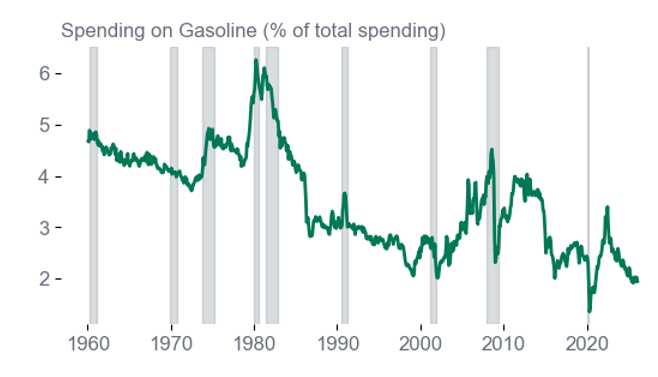
Figure 2: Consumers spending less on gasoline

Gray bars represent recessionary periods. Sources: Bureau of Economic Analysis, Wilmington Trust. Last: January 2026

Helpfully, U.S. households spending on gasoline and diesel as a share of total spending has fallen from about 5% in 1960 to less than 2% at the end of 2025. More efficient automobiles and relatively higher spending on other goods and services diminish the impacts of energy price spikes. However, higher energy prices pose a greater challenge for lower income households, where fuel expenditures make up 7.5% of total spending for the lowest quintile group.

Artificial Intelligence: Disruption, Rotation, and Long‑Term Value

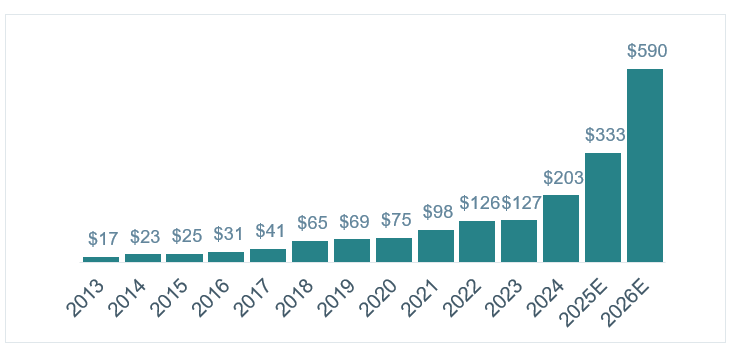
Well before geopolitical tensions intensified, markets were wrestling with a sharp rotation out of mega‑cap tech driven by concerns about the sustainability of AI‑related capital expenditures (capex) and potential disruption of industries from AI. The hyperscalers (i.e. Microsoft, Alphabet, Amazon, Meta, and others) have doubled capex in recent years as they race to build AI infrastructure, with combined spending expected to approach $600 billion in 2026. Of particular note is the increased use of debt to finance the buildout in 2025 and 2026.

Investor Concerns: Monetization and Overbuild

Fourth‑quarter earnings highlighted staggering ongoing investment, sparking fears that the hyperscalers may be overbuilding relative to near‑term demand and clouding the path to profitability on these investments. We see the possibility of overinvestment as a legitimate tail risk, but the evidence today points toward robust, not fading, demand. Oracle’s recent earnings citing more customer demand than it can fulfill for four straight quarters underscores this point.

Valuations have reset accordingly. The S&P 500’s forward P/E multiple has fallen from the 98th percentile of its 25‑year range to roughly the 63rd percentile. Software, viewed as the most exposed to AI disintermediation, has fallen as much as 30% from its late-2025 highs. We think disruption risk across software and other sectors is real. However, we think some well-positioned software companies, particularly those providing the full package of data infrastructure, integrity, integration across other systems and providers, and interfacing, could stand to benefit greatly from AI. Still, history suggests that long‑term leadership in tech shifts repeatedly and AI could be a catalyst for yet another shift in leadership. The giants of one decade rarely dominate the next, underscoring the need for diversification and fundamental analysis, rather than abandonment by investors of an entire segment of the market.

Figure 3: Accelerating Capital Expenditures from Megacap Tech

U.S. capex ($bn) for Microsoft, Meta, Amazon (AWS), Oracle, and Alphabet

Data as of February 6, 2026. Source: Bloomberg, WTIA. Amazon capex discounted for AWS specific spending. 

Labor Market Fears: Real but Contained

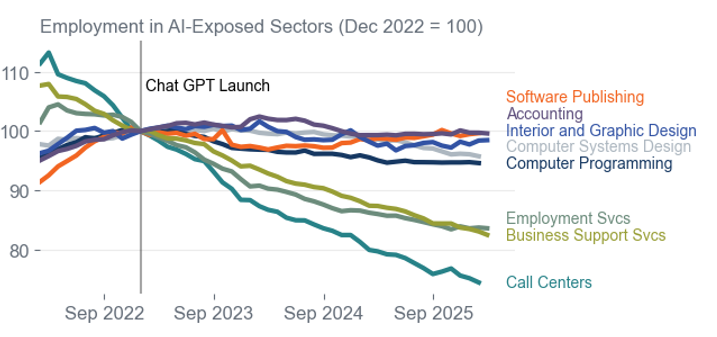
There are legitimate concerns on whether AI will hollow out the labor market. We recognize there have been job losses already, but they are minor relative to the overall economy. Our analysis of sectors most exposed to AI including call centers, business support services, and programming shows job losses of roughly 70,000 since late 2022. Yet over the same period, the rest of the private sector added more than 3.2 million jobs. The disruption is concentrated and meaningful for affected workers, but it remains small relative to the overall labor market. We expect the impact will be larger over time, but we also expect AI to generate new jobs, just as previous technological developments have.

Figure 4: Some AI-related job losses since the launch of Chat GPT

Sources: Bureau of Labor Statistics, Wilmington Trust. Last: February 2026

Market Rotation and Sector Opportunity

As hyperscalers sold off at the end of 2025 and into 2026, traditional cyclicals and defensives—energy, materials, staples, and industrials—outperformed, reflecting investor preference for cash‑flow stability in a volatile environment. Absent from that rotation has been financials, which have lagged the market, weighed down by concerns about private‑credit exposure to software firms, with the software sector making up 20% of overall exposure. This is an evolving story worth monitoring closely. As of right now, the asset class overall is just ~4% of the economy with limited exposure to the banking system. Public market credit conditions look benign, and we do not see material systemic risk.

Our View

AI is a marathon, not a sprint. U.S. corporate leaders across industries have consistently reported meaningful productivity improvements and rising urgency to adopt AI tools. In our judgment, these signals affirm that AI’s long‑term economic payoff remains compelling—even if short‑term market volatility persists.

Core Narrative

The war in Iran is complicating an already-complicated economic and market environment by driving energy prices and uncertainty higher. Our baseline expectation is a resolution in the next two months that allows for oil prices to recede. The spike in crude is driving up gasoline prices and will drive headline inflation higher in the short-term, but we do not expect it to flow through to core inflation. We see the higher prices as dragging on GDP growth a bit. That slower growth combined with little impact on core inflation leads to the Federal Reserve cutting rates three times this year, in our view.

We maintain a full allocation to equities. While uncertainty is high, the market is digesting the risk and volatility is contained. Headline-driven markets are very risky to trade, and we continue to see the overall economic fundamentals as supportive of a full allocation to risk in portfolios. Within equities, we are emphasizing diversification and balancing exposure to both (1) mega‑cap technology, where we believe AI‑driven disruption supports long‑term value creation, and (2) high‑quality equities, which can provide downside resilience should volatility persist. Within fixed income, we retain a preference for investment-grade over high-yield bonds, given the potential softening in economic growth. The market is very fluid and headline driven at the moment, but we continue to be focused on long-term growth and preservation of client capital.

1. Data as of March 19, 2026.

Disclosures

Facts and views presented in this report have not been reviewed by, and may not reflect information known to, professionals in other business areas of Wilmington Trust or M&T Bank who may provide or seek to provide financial services to entities referred to in this report. M&T Bank and Wilmington Trust have established information barriers between their various business groups. As a result, M&T Bank and Wilmington Trust do not disclose certain client relationships with, or compensation received from, such entities in their reports.

The information on Wilmington Wire has been obtained from sources believed to be reliable, but its accuracy and completeness are not guaranteed. The opinions, estimates, and projections constitute the judgment of Wilmington Trust and are subject to change without notice. This commentary is for informational purposes only and is not intended as an offer or solicitation for the sale of any financial product or service or a recommendation or determination that any investment strategy is suitable for a specific investor. Investors should seek financial advice regarding the suitability of any investment strategy based on the investor’s objectives, financial situation, and particular needs. Diversification does not ensure a profit or guarantee against a loss. There is no assurance that any investment strategy will succeed.

References to specific securities are not intended and should not be relied upon as the basis for anyone to buy, sell, or hold any security. Holdings and sector allocations may not be representative of the portfolio manager’s current or future investment and are subject to change at any time. Reference to the company names mentioned in this material are merely for explaining the market view and should not be construed as investment advice or investment recommendations of those companies.

Past performance cannot guarantee future results. Investing involves risk and you may incur a profit or a loss.

Indexes are not available for direct investment. Investment in a security or strategy designed to replicate the performance of an index will incur expenses such as management fees and transaction costs which will reduce returns.

Any investment products discussed in this commentary are not insured by the FDIC or any other governmental agency, are not deposits of or other obligations of or guaranteed by M&T Bank, Wilmington Trust, or any other bank or entity, and are subject to risks, including a possible loss of the principal amount invested.

Investments that focus on alternative assets are subject to increased risk and loss of principal and are not suitable for all investors.

Stay Informed

Subscribe

Ideas, analysis, and perspectives to help you make your next move with confidence.

Sign Up Now

WTU Newsletter Card
WTU Newsletter Handler