Equal Housing Lender. © 2026 M&T Bank and its affiliates and subsidiaries. NMLS #381076. Member FDIC.
Planning for retirement involves more than simply saving— it requires making informed decisions about how and when your retirement assets will be taxed. One of the most common questions investors face is whether Roth or traditional retirement accounts are the better choice, especially as Roth IRAs and Roth conversions continue to grow in popularity.
While there is no universal answer, understanding the tax advantages, contribution rules, conversion strategies, required minimum distribution (RMD) implications, and estate planning benefits of Roth accounts can help you make more confident, tax-efficient decisions. By evaluating current and future tax rates, income needs, and legacy goals, Roth planning can play a powerful role in creating long-term financial flexibility and potentially tax-free income in retirement.
The first thing to understand is why someone would consider Roth contributions or conversions. Generally, when you contribute to a qualified retirement plan (IRA, 401(k), 403(b), etc.) you have the option to contribute on a pre-tax basis (traditional) or after-tax basis (designated as Roth). If you contribute on a traditional basis, your contribution is not included in your income for that year, making it a current tax year saving strategy. However, when you ultimately withdraw those contributions in the future, both the contributions and the appreciation on them are fully taxable at that time. You are simply deferring paying tax on the contributions to a later date. Roth contributions work the opposite way. A Roth contribution is not a current tax year saving strategy since the contributions are still included in your income that year. However, when you ultimately withdraw the Roth contributions, both the contributions and the appreciation are not taxable, so long as they are qualified distributions.
The ability for Roth contributions, and their appreciation, to grow and be withdrawn tax free is the main benefit of using Roth for retirement planning. It can provide income tax flexibility in retirement years. The trade-off for this benefit, of course, is paying tax on the contributions when you make them.
Other advantages of using Roth contributions or conversions are that there are no required minimum distributions (RMDs) from Roth designated assets. The account owner never has to take a distribution as long as they are alive. This is not the case for the traditional retirement account assets, which require distributions (and the associated income tax) to begin at a specific age. After the account owner’s death, a spousal beneficiary also has no requirement to take distributions from a Roth account. Non-spousal beneficiaries do have distribution requirements after they inherit Roth assets, and the tax-free nature of the assets can make it an immensely beneficial asset to inherit.
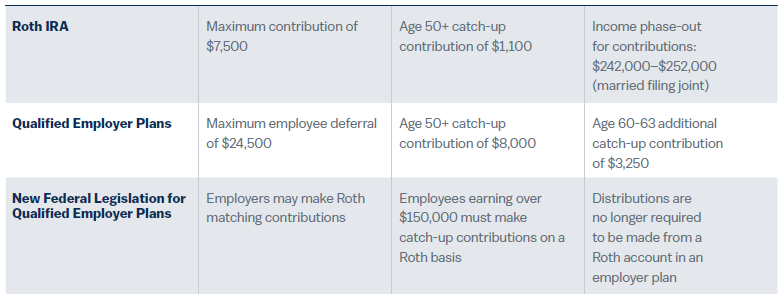
There are two ways to get money into a Roth account: a contribution or a conversion. Contributions are made to an individual retirement account (Roth IRA) or to an employer’s retirement plan (401(k), 403(B), etc.) that allows them. Since you must have earned income to contribute to these accounts, contributions are made while you are still working. Contributions to a Roth IRA are restricted by income limits, so not everyone can contribute. There are no such income limitations to contributing to an employer’s plan on a Roth basis, however.
A Roth conversion, on the other hand, does not require any income to execute. Therefore, it can be done at any time by anyone as a way to move traditional (pre-tax) retirement assets into a Roth account. Once this has been done, the account benefits from all of the advantages that Roth assets offer. The major factor here, however, is that any funds converted from traditional to Roth are taxable income in the year of the conversion. This is what makes planning a critical component of any Roth conversion strategy.
As with most financial planning strategies, everyone has their own unique circumstances to consider. The following variables are some of those circumstances that should be reviewed when contemplating Roth contributions and conversions. As this is not a complete list, it is recommended that you consult with your financial and tax advisors prior to implementing any strategies.
You have choices when it comes to planning for your future. Traditional and Roth assets can both benefit your plan in their own respective ways. Taking all of your specific circumstances and goals into consideration can help you make the best decision.
Data source: www.irs.gov
This article is for informational purposes only and is not intended as an offer or solicitation for the sale of any financial product or service. It is not designed or intended to provide financial, tax, legal, accounting, investment, or other professional advice since such advice always requires consideration of individual circumstances. Note that tax, estate planning, investing, and financial strategies require consideration for suitability of the individual, business, or investor, and there is no assurance that any strategy will be successful.
The information in this article has been obtained from sources believed to be reliable, but its accuracy and completeness are not guaranteed. The opinions, estimates, and projections constitute the judgment of Wilmington Trust and are subject to change without notice.
Wilmington Trust is not authorized to and does not provide legal, accounting, or tax advice. Our advice and recommendations provided to you are illustrative only and subject to the opinions and advice of your own attorney, tax advisor, or other professional advisor.
Investing involves risks, and you may incur a profit or a loss.
Wilmington Trust is a registered service mark used in connection with various fiduciary and non-fiduciary services offered by certain subsidiaries of M&T Bank Corporation including, but not limited to, Manufacturers & Traders Trust Company (M&T Bank), Wilmington Trust Company (WTC) operating in Delaware only,
Wilmington Trust, N.A. (WTNA), Wilmington Trust Investment Advisors, Inc. (WTIA), Wilmington Funds Management Corporation (WFMC), Wilmington Trust Asset Management, LLC (WTAM), and Wilmington Trust Investment Management, LLC (WTIM). Such services include trustee, custodial, agency, investment management, and other services. Loans, credit cards, retail and business deposits, and other business and personal banking services and products are offered by M&T Bank, Member FDIC.
Investment Products: Are NOT FDIC Insured | Have NO Bank Guarantee | May Lose Value
Stay Informed
Subscribe
Ideas, analysis, and perspectives to help you make your next move with confidence.
What can we help you with today