Skip to Main Content
 Equal Housing Lender. © 2026 M&T Bank and its affiliates and subsidiaries. NMLS #381076. M&T Bank Member FDIC.
Wilmington Trust is a registered service mark used in connection with various fiduciary and non-fiduciary services offered by certain subsidiaries of M&T Bank Corporation including, but not limited to, Manufacturers & Traders Trust Company (M&T Bank), Wilmington Trust Company (WTC) operating in Delaware only, Wilmington Trust, N.A. (WTNA), Wilmington Trust Investment Advisors, Inc. (WTIA), Wilmington Funds Management Corporation (WFMC), Wilmington Trust Asset Management, LLC (WTAM), and Wilmington Trust Investment Management, LLC (WTIM). Such services include trustee, custodial, agency, investment management, and other services. International corporate and institutional services are offered through M&T Bank Corporation’s international subsidiaries. Loans, credit cards, retail and business deposits, and other business and personal banking services and products are offered by M&T Bank. Member, FDIC. 
M&T Bank Corporation’s European subsidiaries (Wilmington Trust (UK) Limited, Wilmington Trust (London) Limited, Wilmington Trust SP Services (London) Limited, Wilmington Trust SP Services (Dublin) Limited, Wilmington Trust SP Services (Frankfurt) GmbH and Wilmington Trust SAS) provide international corporate and institutional services.
WTIA, WFMC, WTAM, and WTIM are investment advisors registered with the U.S. Securities and Exchange Commission (SEC). Registration with the SEC does not imply any level of skill or training. Additional Information about WTIA, WFMC, WTAM, and WTIM is also available on the SEC's website at adviserinfo.sec.gov. 
Private Banking is the marketing name for an offering of M&T Bank deposit and loan products and services. Custom credit advisors are M&T Bank employees. Loans, retail and business deposits, and other personal and business banking services and products are offered by M&T Bank.
Investment and Insurance Products  • Are NOT Deposits • Are NOT FDIC Insured • Are NOT Insured By Any Federal Government Agency • Have NO Bank Guarantee • May Go Down In Value  
Investing involves risks and you may incur a profit or a loss. Past performance cannot guarantee future results. This material is provided for informational purposes only and is not intended as an offer or solicitation for the sale of any security or service. It is not designed or intended to provide financial, tax, legal, accounting, or other professional advice since such advice always requires consideration of individual circumstances. There is no assurance that any investment, financial or estate planning strategy will be successful.
About Us
Wealth Management
Insights

It is said that the equity market climbs a “wall of worry.” In other words, there are always a number of risks on the horizon for investors, and in fact it is usually the case that the downside risks are easier to enumerate than the upside potential. Today is no different.

We started off the year with a number of “bricks” being added to that wall. The job market looked to be rolling over, with the three-month moving average of nonfarm payrolls turning negative at the end of 2025. Investor angst over Artificial Intelligence escalated, as the somewhat opposing ideas of overinvestment and labor market evisceration hit the tech sector hard. Private credit, with its exposure to the software industry and significant capital withdrawals, was caught up in the mix. Then the war broke out, and the S&P 500 corrected nearly 10% (based on intraday drawdown), before recovering all of its losses in just 10 trading days—one of the fastest recoveries from a 10% drawdown in history.

The market is now on the ascent, making new highs. Stocks may seem disconnected from reality considering, despite signs of progress between the U.S. and Iran, geopolitical risk remains at a boil. But in our view, several of the “bricks” mentioned above have crumbled (in a good way), clearing a path for the market to move higher.

We expect the equity market to end the year higher, though market momentum could moderate as we approach a mid-term election expected to usher in split fiscal control in Washington. We are also wary of the downside risks presented by war-related headlines, a slowing consumer, and relatively concentrated market gains. Nonetheless, the remarkable earnings power of corporate America, ever fed by an insatiable demand for AI, cannot be ignored. As a result, we continue to position client portfolios with a full allocation to equities, a defensive posture within fixed income, and an abiding preference for high-quality, growth-oriented companies.

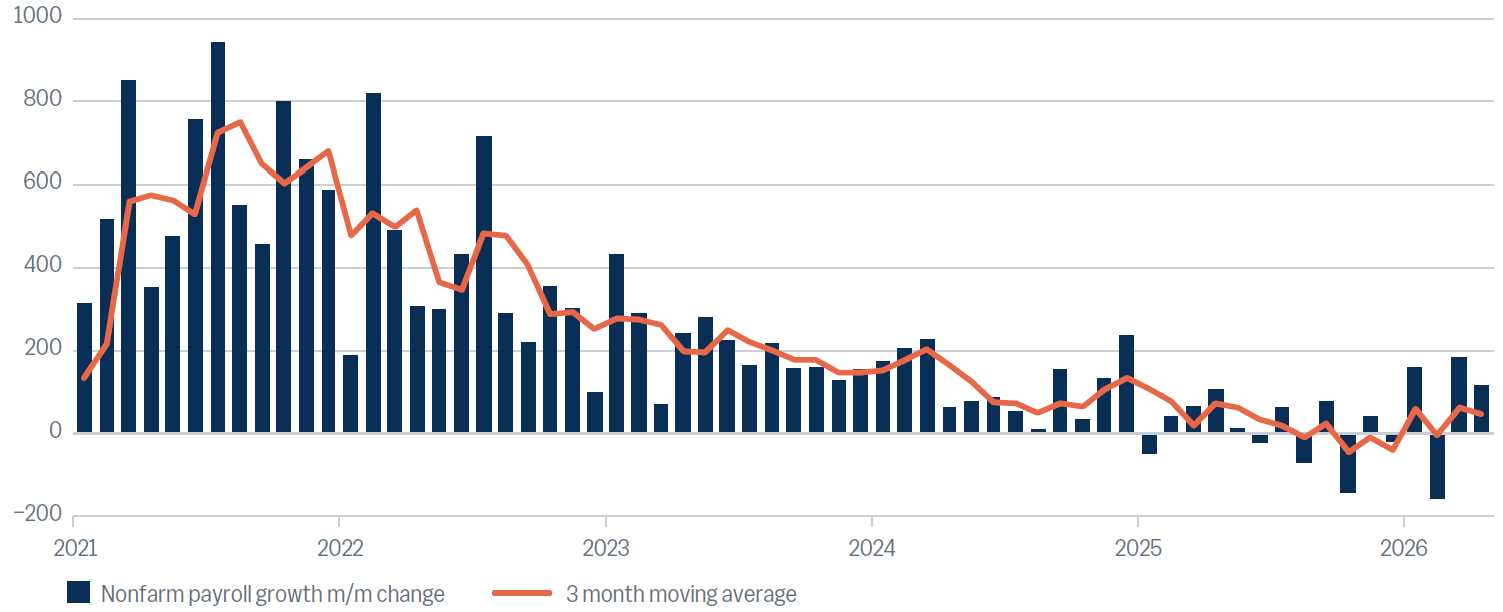
Figure 1: Job market may be improving
U.S. nonfarm payroll monthly net new jobs (thousands)

Source: Bureau of Labor Statistics, Wilmington Trust. As of March 31, 2026.

A tale of two economies

Our assessment of the economy is that it is in solid shape but slowing. We expect GDP growth of 1.5% for 2026 and a slight increase in the unemployment rate. Headline inflation has been sticky and is at risk of increasing given the current historic oil supply disruption. However, we anticipate only modest pass-through to core inflation, particularly as an inflation-fatigued consumer is in no place to accept further price increases. Gradual disinflation will, in our view, result in three rate cuts from the Federal Reserve in the second half of 2026.

Digging a layer deeper, we often talk about “the economy” as if it were a singular phenomenon, but today we are struck by the theme of “divergence.”  Whether we focus on consumer spending, the labor market, or business investment, a single narrative does not tell the whole story.

In the case of the labor market, we’re seeing nascent signs of an encouraging turnaround after flirting with job losses in 2025. The health care  sector is a steadfast job engine given ongoing demographic trends and an ever-growing need for health care services. But peeling away health care and looking at the remainder of private sectors, we saw 250,000 jobs cut from May to December last year, typically a harbinger of recession. Fortunately, we are seeing signs of stabilization and potentially even re-acceleration in the labor market (Figure 1), which has been broad-based and led to a modest downgrade of our recession probability to 40%.

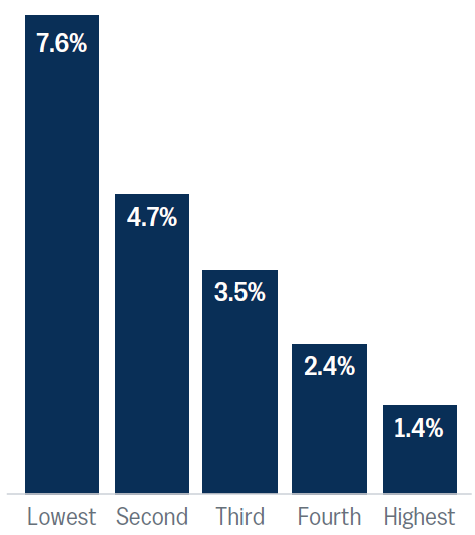
Figure 2: Lower income consumer more exposed to rising oil prices
Spending on gasoline and diesel by income quintile (% of spending)

Data as of December 31, 2025. Source: Bureau of Labor Statistics, Wilmington Trust.

Consumer spending is similarly divergent. The high-income consumer—ever driven by financial asset inflation—continues to spend on goods and services, but the low-end consumer is spending less, with a greater share of that spending on essentials, including gasoline. While we acknowledge that the high-income consumer typically punches above its weight, this “K-shaped” consumer dynamic could be further exacerbated if U.S.-Iran talks fall apart and oil prices move higher. The lowest income quintile spends over 7% of their income on gasoline, compared to less than 2% for the highest quintile (Figure 2).

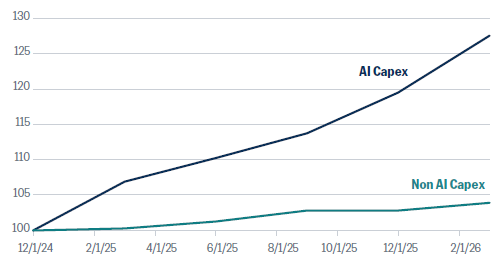
And then there is the Artificial Intelligence investment supercycle, which is powering business investment and corporate earnings growth. We believe we are still in the middle innings of the AI infrastructure buildout, and demand for chips and cloud storage continues to outstrip available supply. Yet outside of AI, business investment has been very sluggish (Figure 3).

We will gladly welcome economic growth from whatever segments of the economy are able to provide it. Yet we would argue that an economy growing from a broader base is a healthier, more sustainable growth story. We believe we could see broader growth from the labor market, consumer, and capital expenditures (capex) as tariff and war uncertainty fades, and the Fed lowers interest rates in the second half of the year.

Figure 3: AI investment supercycle is driving the majority of capex
AI vs. non-AI capex (indexed to 200 on December 31, 2024)

Source: Bloomberg.

An earnings story to write home about

And dare we coin the “Great Divergence”—the overall economy may be slowing while corporate earnings growth is accelerating at a rapid pace. At the time of writing, we are mid-way through reporting season for first quarter earnings. The S&P 500 is now projected to realize earnings growth of 27% y/y in the first quarter.1 That is more than double the earnings growth expected at the close of the first quarter. This upward revision is very much out of the norm, as earnings estimates are typically revised down through the quarter.

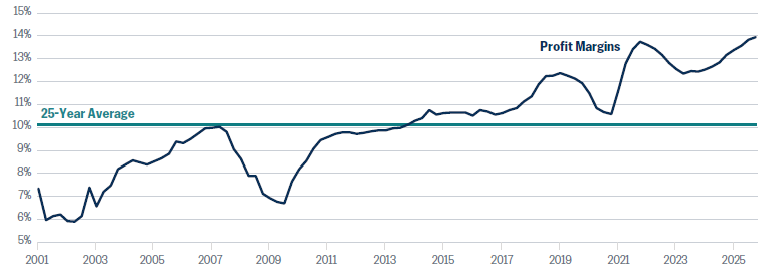
As with the economy, the earnings picture is exhibiting a divergence with exceptional earnings growth concentrated in technology, communications services, and consumer discretionary (the latter thanks mostly to Amazon). Outside of these sectors earnings growth is far lower but very respectable, with materials, financials, real estate, industrials, and utilities all projected to grow earnings at double digits. Solid top-line growth and exceptional earnings have helped profit margins for the S&P 500 climb to a new 25-year high (Figure 4).

Figure 4: Profit margins make new highs
S&P 500 profit margin (trailing 12 month)

Source: Bloomberg. As of April 30, 2026.

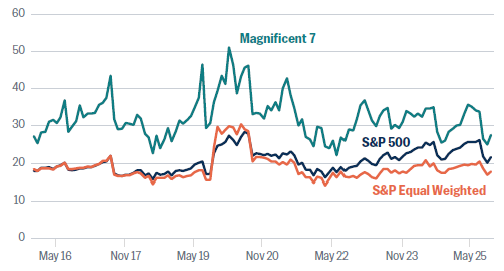
Upward revisions to earnings have outpaced the stock market’s return, so the 12-month-forward price-to-earnings ratio has declined from the 99th percentile a few months ago to the 67th today.
The market is not cheap, but valuations appear reasonable to us when all factors are considered (Figure 5).  

Figure 5: U.S. equity valuations decline alongside strong earnings
Forward price-to-earnings ratio

Source: Bloomberg. As of April 30, 2026.

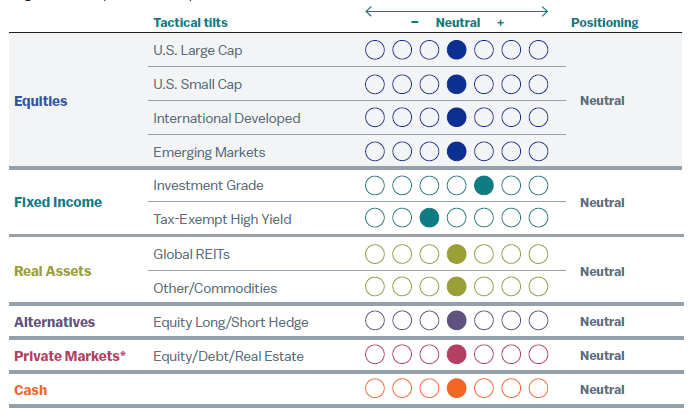
Figure 6: Asset class positioning
High-net-worth portfolios with private markets*

* Private markets are only available to investors that meet Securities and Exchange Commission standards and are qualified and accredited. We recommend a strategic allocation to private markets but do not tactically adjust this asset class.

Data as of April 30, 2026.

Positioning reflects our monthly tactical asset allocation (TAA) versus the long-term strategic asset allocation (SAA) benchmark. For an overview of our asset allocation strategies, please see the disclosures.


Positioning portfolios in the fog of war

Excluding the war, the overall economic and earnings stories are very constructive. We have pushed rate cuts out a bit, now expecting two 25 basis point rate cuts in the second half of the year, but not altering our expectation for the overall trajectory of Fed policy. Our Fed call is out of consensus, but if we are right, a lower fed funds rate would further ease borrowing costs for businesses and consumers. If we are wrong, we would argue that it is because job growth is coming in stronger than expected, not because inflation is running away from the Fed. This would be a positive—perhaps even “Goldilocks”—scenario for equities, as historically equities have proven a resilient hedge against moderate inflation with solid growth.

Geopolitical uncertainty remains the primary risk. Our base case is that the war is resolved—defined here only by a clear path to reopen the Strait of Hormuz—in coming weeks. However, we recognize that if the Strait stays closed for appreciably longer, lower-end consumers could capitulate to higher energy prices. The U.S. is more insulated than other parts of the world, but extending the conflict a bit longer could result in a more dramatic increase in oil prices that would, all else equal, increase recession risks.

There are other risks we are watching as well. These include the expiration of the universal 10% tariffs in July and, further down the line, the midterm elections. Businesses abhor uncertainty, and while they have done a remarkable job of adjusting to an ever-changing landscape, these catalysts could impair business hiring and investment in the second half of the year.

As such, we remain patient in adjusting portfolios. We continue to hold a neutral allocation to equities (Figure 6) with a preference for high-quality companies and a bias toward growth over value. Within fixed income, we hold an overweight to investment-grade over high-yield versus our strategic  benchmark.

We find ourselves in unusual and uncertain times. Investors who choose to sit out of the market awaiting the “all clear” to add to risk will likely be waiting forever. We feel it is important to stay invested during this time, and we will continue to monitor the landscape, seeking prudent investment opportunities to help our clients achieve their goals.

Sources:

1. Factset, as of May 1, 2026.


Please see important disclosures at the end of the article.

Talk with our team

Please complete the form below and one of our advisors will reach out to you.

* Indicates a required field.

Do you work with a contact at Wilmington Trust?*

This site is protected by reCAPTCHA.

WTU Form Handler

Stay Informed

Subscribe

Ideas, analysis, and perspectives to help you make your next move with confidence.

Sign Up Now

WTU Newsletter Card
WTU Newsletter Handler