Skip to Main Content
© 2025 M&T Bank and its affiliates and subsidiaries. All rights reserved.
Wilmington Trust is a registered service mark used in connection with various fiduciary and non-fiduciary services offered by certain subsidiaries of M&T Bank Corporation including, but not limited to, Manufacturers & Traders Trust Company (M&T Bank), Wilmington Trust Company (WTC) operating in Delaware only, Wilmington Trust, N.A. (WTNA), Wilmington Trust Investment Advisors, Inc. (WTIA), Wilmington Funds Management Corporation (WFMC), Wilmington Trust Asset Management, LLC (WTAM), and Wilmington Trust Investment Management, LLC (WTIM). Such services include trustee, custodial, agency, investment management, and other services. International corporate and institutional services are offered through M&T Bank Corporation’s international subsidiaries. Loans, credit cards, retail and business deposits, and other business and personal banking services and products are offered by M&T Bank. Member, FDIC. 
M&T Bank Corporation’s European subsidiaries (Wilmington Trust (UK) Limited, Wilmington Trust (London) Limited, Wilmington Trust SP Services (London) Limited, Wilmington Trust SP Services (Dublin) Limited, Wilmington Trust SP Services (Frankfurt) GmbH and Wilmington Trust SAS) provide international corporate and institutional services.
WTIA, WFMC, WTAM, and WTIM are investment advisors registered with the U.S. Securities and Exchange Commission (SEC). Registration with the SEC does not imply any level of skill or training. Additional Information about WTIA, WFMC, WTAM, and WTIM is also available on the SEC's website at adviserinfo.sec.gov. 
Private Banking is the marketing name for an offering of M&T Bank deposit and loan products and services. Custom credit advisors are M&T Bank employees. Loans, retail and business deposits, and other personal and business banking services and products are offered by M&T Bank  Equal Housing Lender. Bank NMLS #381076. Member FDIC.
M&T Bank  Equal Housing Lender. Bank NMLS #381076. Member FDIC. 
Investment and Insurance Products  • Are NOT Deposits • Are NOT FDIC Insured • Are NOT Insured By Any Federal Government Agency • Have NO Bank Guarantee • May Go Down In Value  
Investing involves risks and you may incur a profit or a loss. Past performance cannot guarantee future results. This material is provided for informational purposes only and is not intended as an offer or solicitation for the sale of any security or service. It is not designed or intended to provide financial, tax, legal, accounting, or other professional advice since such advice always requires consideration of individual circumstances. There is no assurance that any investment, financial or estate planning strategy will be successful.
About Us

GET IN TOUCH

Wealth Management
Insights

Trust features to facilitate fiduciary decision making

Key takeaways

  • When a business interest is the primary asset in a trust, it can create challenges for both the trustee and business owner
  • The trustee’s general fiduciary duty to diversify the trust’s investments may not align with the business owner’s goals
  • Certain trust features can help to address this conflict


One of the biggest hurdles for business owners considering estate planning using personal trusts is the fear of giving up control over their most significant asset. After many years of successfully leading their company, they are understandably reluctant to let anyone else make decisions about how it is managed as an asset.

Under most traditional trust structures, the trustee is responsible for assets placed in trust. The trustee must make decisions about how to manage these  assets—which can be particularly challenging when the primary asset is a  closely held business. Because of its fiduciary duty to diversify the trust’s  investments, a trustee may decide that a closely held business is not an  appropriate investment for the trust, because it is undiversified and illiquid, and may decide to sell all or part of the ownership interest or manage it in a manner that is contrary to the family’s goals. This, obviously, is not what most business owners want.

However, these issues can be addressed by establishing a trust with specific fea[1]tures that allow the business to remain as the trust’s primary asset while a trust[1]ee performs the administrative duties required. The state law governing a trust’s administration and a trustee’s experience using these tools will determine a trustee’s willingness and ability to administer a trust holding business assets.

Directed trust language

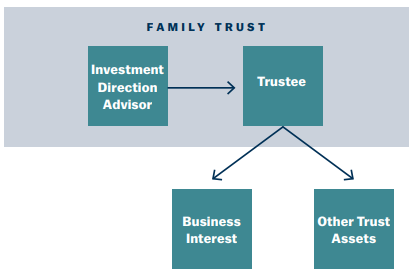
With a directed trust, the trust document provides that the investment advisor manages all trust investments, including business interests (see Figure 1). The investment advisor thus makes decisions on voting, retention, and sale of assets. The trustee is required to follow the written directions of the investment advisor, however the trustee is still responsible for performing the administrative functions of the trust. The trustee may need to manage the business interests if no investment advisor is serving.

Figure 1: Directed trust
Trustee follows directions of investment advisor

Special business co-trustee language

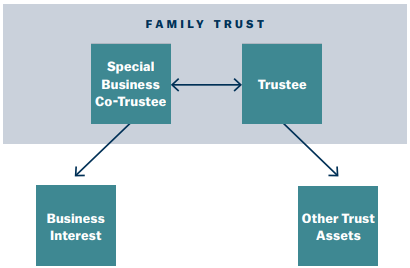
A special business co-trustee manages the business interests for a family trust in conjunction with a primary trustee. The special business trustee can exercise voting power and make decisions regarding retention, sale, and encumbrance, while the primary trustee retains the management of all other trust assets (see Figure 2). The primary trustee is required by the trust document to implement the administrative tasks based upon the special business co-trustee’s management of the business interests. Because there are co-fiduciary duties shared between the primary trustee and special business trustee, the relationship may be cumbersome. Some states, such as Delaware, provide for an “excluded co-trustee” relationship where the primary trustee may be excluded from all aspects of administering special business assets. An excluded co[1]trustee statute helps clarify the scope of each trustee’s duties and liability.

Figure 2: Special business co-trustee
Primary trustee has not responsibility over business interest

Delegation by trustee language

Trustees may also choose to delegate responsibility to a third party or to a co-trustee (see Figure 3). By exercising reasonable care in the selecting and monitoring of the delegate, the trustee is generally not responsible for the decisions or actions of the delegate. The delegate manages the business interests held in the trust. Unlike investment advisors or special business co-trustees, the trustee has the duty to periodically review the actions of the delegate. However, the beneficiaries of the trust can execute agreements to consent to the delegation and exonerate and indemnify the trustee.

Figure 3: Delegation by trustee
Trustee delegates authority for delegate to manage business interests

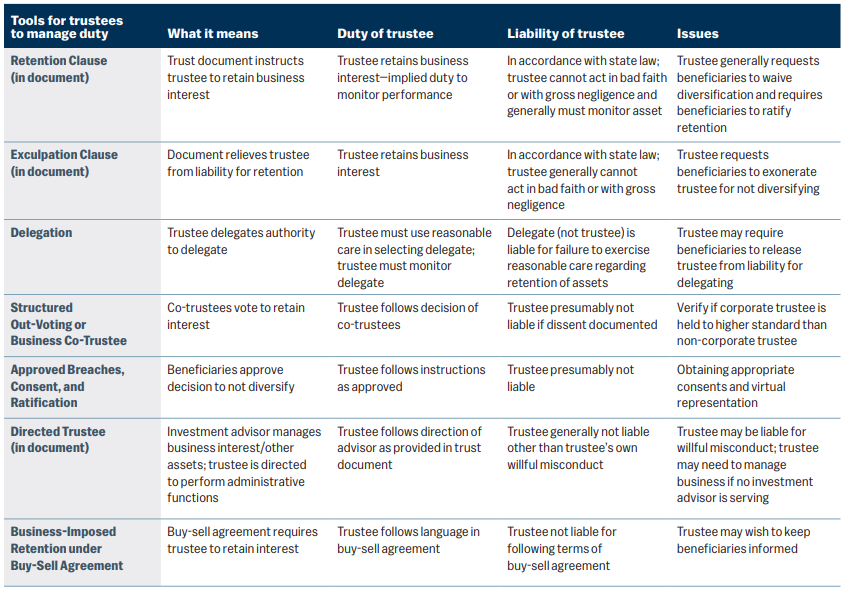
Figure 4: Managing the trustee’s duty to diversify
A trustee’s willingness and ability to utilize these tools to hold business interests will depend upon applicable state law as well as the trustee’s experience and risk tolerance


Your Journey, In Perfect Harmony

We can help you orchestrate your financial life—let our experience guide every movement, both personal and professional.

Learn More >


This article is for informational purposes only and is not intended as an offer or solicitation for the sale of any financial product or service. This article is not designed or intended to provide financial, tax, legal, accounting, or other professional advice since such advice always requires consideration of individual circumstances. If professional advice is needed, the services of a professional advisor should be sought. Note that a few states, including Delaware, have special trust advantages that may not be available under the laws of your state of residence, including asset protection trusts and directed trusts.


Wilmington Trust is not authorized to and does not provide legal, tax, or accounting advice. Our advice and recommendations provided to you are illustrative only and subject to the opinions and advice of your own attorney, tax advisor, or other professional advisor.


Note that financial and estate planning strategies require consideration for suitability of the individual, business, or investor, and there is no assurance that any strategy will be successful.

{{w-d159}}

Stay Informed

Subscribe

Ideas, analysis, and perspectives to help you make your next move with confidence.

Sign Up Now

WTU Newsletter Card
WTU Newsletter Handler