Equal Housing Lender. © 2026 M&T Bank and its affiliates and subsidiaries. NMLS #381076. M&T Bank Member FDIC.
Institutional Services Insights
Wealth Management Insights
Who We Are
Log In
Select Business Area
Our Services
Institutional Services Insights
A financial windfall can arrive in many ways: an inheritance, lottery or prize winnings, the sale of property or a business, an insurance payout, or another unexpected source of money. However it happens, receiving a large sum can feel exciting, unsettling, and overwhelming all at once. You may feel pressure to make the “right” decision immediately, especially if this is more money than you have ever managed before.
The good news is that you do not need to become a financial expert overnight. A measured approach can help you turn a one-time event into a source of greater security, flexibility, and opportunity.
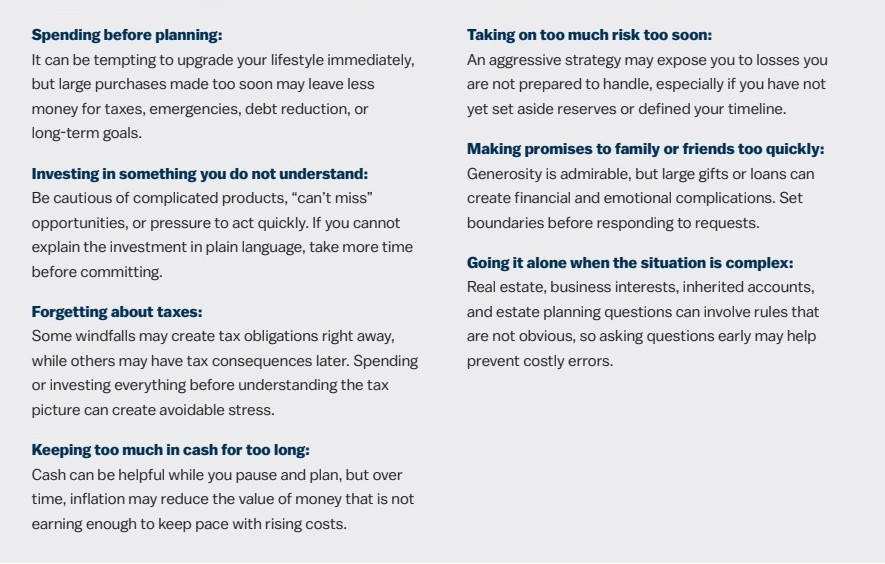
When money arrives unexpectedly, it is natural to want to act quickly. You may want to pay off debt, help family members, make a major purchase, invest, donate, or simply celebrate. Some of those decisions may make sense, but not all of them need to happen right away.
Before making major financial moves, consider placing the money somewhere secure and accessible while you learn more about your options. For cash held at a bank, deposit insurance generally applies only to eligible deposit accounts at insured institutions and is subject to coverage limits based on the depositor, ownership category, and bank. If your windfall is large, it may be worth asking your bank or advisor whether your cash is fully protected while you decide what to do next.
A pause does not mean doing nothing. During this early period, gather documents, list questions, avoid promising money to others, and resist pressure from anyone urging you to act before you are ready. You do not need to have every answer right away; you simply need a safe place to begin.
Not all windfalls are the same. A cash inheritance is different from shares of stock, a piece of real estate, retirement account assets, business proceeds, or prize winnings. The type of asset you receive can affect how easily you can use the money, how it may be taxed, and what records you need to keep.
Start by making a simple inventory. What did you receive? Do you already own other assets that should be considered alongside the windfall? Do you have debts, upcoming expenses, or family obligations that may affect how much flexibility you really have?
You will also want to understand whether taxes, fees, or other obligations may apply. Lottery and prize winnings, inherited assets, property sales, and retirement accounts may each be treated differently. Speaking with a tax professional before using the full amount can help you avoid surprises.
Once you understand what you have and what obligations may come with it, you can begin thinking about what you want the money to make possible.
Before you decide how to invest or use the money, think about what you want it to make possible. For some people, a windfall is a chance to feel safer: paying down high-interest debt, building emergency savings, catching up on retirement contributions, or reducing monthly financial stress. For others, it may help fund education, support children or grandchildren, start a business, buy a home, retire sooner, or give to causes they care about.
You do not have to choose only one goal. A thoughtful plan often divides money into different “buckets” based on when and how you may need it. Money needed soon may belong in safer, more accessible accounts. Money intended for goals many years away may be invested differently, with an understanding that investments can rise and fall in value.
Once you have a clearer sense of your priorities, the next step is determining who can help you turn those priorities into a practical plan.
If you are not used to working with financial professionals, asking for help can feel intimidating. But a windfall is exactly the kind of moment when guidance can make a meaningful difference. You do not need to understand every tax rule, investment option, or estate planning term before you meet with someone. A good advisor should be able to explain your choices clearly and help you move at a pace that feels manageable.
Depending on your situation, your team may include a financial advisor, a CPA or tax professional, an estate planning attorney, and possibly an insurance professional. Together, they can help you decide how much to keep in cash, what tax issues to address, how to invest appropriately, and whether beneficiary or estate documents should be updated.
As you choose professionals, look for people who take time to listen, explain fees, communicate clearly, and respect your comfort level. If someone makes you feel rushed, confused, or pressured into a product you do not understand, it is reasonable to pause and seek another opinion.
It can be tempting to focus first on how to make the money grow, but protection comes first. That means setting aside cash for near-term needs, maintaining an emergency fund, accounting for taxes or debt, and choosing an investment approach that fits your risk tolerance.
Investing does not have to be mysterious. At a basic level, investing means deciding how much of your money should be held in cash, bonds, stocks, or other assets based on your goals, your timeline, and how much risk you can tolerate. Money you expect to need soon is usually treated differently than money meant for retirement or another goal many years away. Diversification—spreading money across different types of investments—can help reduce the risk of relying too heavily on any one investment.
It is also important to remember that saving and investing are not the same. Savings are generally intended to be safer and more accessible, while investments may offer greater long-term growth potential but can also decline in value. Understanding that difference can help you decide what should remain readily available and what can be invested for the future.
Receiving unexpected money can bring relief, opportunity, and responsibility. You may not know exactly what to do yet, and that is okay. Start by slowing down, keeping the money safe, learning what you have, and identifying what matters most. Then surround yourself with people who can help you make informed decisions. With patience and the right guidance, a windfall can support your goals today while helping build a more secure future for tomorrow.
A sudden increase in wealth can bring both opportunity and complexity. Explore our wealth planning capabilities to help create a strategy for preserving, growing, and transferring wealth with confidence.
This article is for educational purposes only and is not intended as an offer or solicitation for the sale of any tax, estate planning, or financial product or service, or a recommendation or determination that any tax, estate planning, or investment strategy is suitable for a specific investor. Investors should seek financial advice regarding the suitability of any investment strategy based on their objectives, financial situations, and particular needs. This article is not designed or intended to provide financial, tax, legal, accounting, or other professional advice since such advice always requires consideration of individual circumstances. If professional advice is needed, the services of a professional advisor should be sought.
There is no assurance that any investment, financial, or estate planning strategy will be successful.
The information in this article has been obtained from sources believed to be reliable, but its accuracy and completeness are not guaranteed.
Wilmington Trust is not authorized to and does not provide legal, tax, or accounting advice. Our advice and recommendations provided to you are illustrative only and subject to the opinions and advice of your own attorney, tax advisor, or other professional advisor.
Investing involves risks and you may incur a profit or a loss. Diversification cannot guarantee a profit or protect against a loss.
Wilmington Trust is a registered service mark used in connection with various fiduciary and non-fiduciary services offered by certain subsidiaries of M&T Bank Corporation including, but not limited to, Manufacturers & Traders Trust Company (M&T Bank), Wilmington Trust Company (WTC) operating in Delaware only, Wilmington Trust, N.A. (WTNA), Wilmington Trust Investment Advisors, Inc. (WTIA), Wilmington Funds Management Corporation (WFMC), Wilmington Trust Asset Management, LLC (WTAM), and Wilmington Trust Investment Management, LLC (WTIM). Such services include trustee, custodial, agency, investment management, and other services. International corporate and institutional services are offered through M&T Bank Corporation’s international subsidiaries. Loans, credit cards, retail and business deposits, and other business and personal banking services and products are offered by M&T Bank, Member FDIC.
Investments: Are NOT FDIC Insured | Have NO Bank Guarantee | May Lose Value
Please complete the form below and one of our advisors will reach out to you.
Stay Informed
Subscribe
Ideas, analysis, and perspectives to help you make your next move with confidence.
What can we help you with today