Source: Bloomberg. Data as of November 5, 2026.
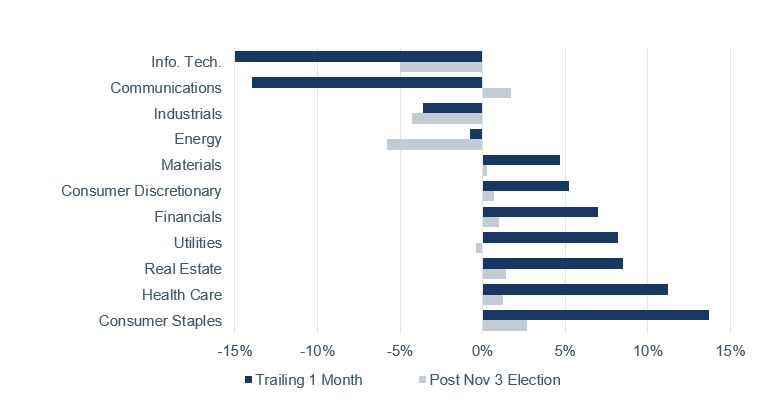
The “data center trade” has been in decline since June, which has also coincided with more broad-based opposition to data centers at the local level, specifically from government officials across Texas, New York, Ohio, and Vermont. The Philadelphia Stock Exchange Semiconductor Index is now 37% off its June highs. The Nasdaq 100 made a new high in October, despite the rotation out of chips, but is down 14% in the past month.
A significant slowing of AI-related investment could reverberate through the economy, given it has been directly responsible for more than half of growth of non-residential domestic capital expenditures over the last 12 months and roughly 20% of nominal Gross Domestic Product (GDP) growth. If reduced tech capex weighs on economic growth, and related debt issuance slows, we would expect to see long interest rates fall. Indeed, rates are lower on the week and the month, and Treasuries are enjoying a flight-to-quality rally as investors seek out safety.
There is significant uncertainty around tech spending, and we highlighted the anti-data-center movement as a key risk to the midterm elections. However, we think the degree of bearishness in the market today should be tempered. Blue-state politicians are being painted as anti-AI, which we believe is a hasty generalization. If their goal is to “build it right,” rather than “don’t build it at all,” the issue will be a matter of reducing the speed rather than changing direction.
A slowing of tech capex could certainly have a dampening impact on AI adoption and earnings growth for the market, forcing a reset of asset prices. But we are of the view that these “rolling waves of pessimism” in tech could help elongate the market cycle and avoid a bubble, by moderating valuations and earnings expectations along the way.
We also think the AI cat is out of the bag, and demand plus national security priorities will ultimately force the conversation more toward incentives data center builders can provide to communities. These might include tax incentives, funding for schools, and energy credits. In this scenario, hyperscalers have more financial flexibility to sweeten the pot than the more concentrated neoclouds.
AI-related carnage in the markets is leading to outperformance of less tech-centric asset classes such as international developed and U.S. small-cap equities. Lower interest rates, lower oil prices, and hopes of reduced tariffs (we are skeptical of the latter) are also supporting this rotation. Portfolio diversification is illuminated in periods like this, with healthcare, staples, utilities, and communication services holding up on a relative basis. We would expect a continued AI-related selloff to benefit the diversified investor, though we continue to think the economic growth outlook is strongest in the U.S. versus other developed economies. Unlike developed international, emerging market equities are largely a concentrated AI bet. We retain an overweight to this asset class on a long-term constructive view for tech, and we believe there is positive optionality in valuations, which are very cheap for the asset class relative to the S&P 500.
Outlook for Oil
AI was not the only issue on the ballot. Oil prices are sharply lower on the week (though reversing a bit from Wednesday’s -9% move for Brent), with the view being that the overwhelming victory from Democrats was a referendum on affordability, energy prices, and more specifically, the war in Iran.
We would caution against extrapolating too far with this theme, as the war has always been less of a Republican-led issue and an exercise of presidential authority. We have also noted that oil exports out of the Middle East are back to about 90% of pre-war levels. Supply is flowing better, but energy prices remain elevated because of uncertainty, shipping costs and insurance, and limited refining capacity. These issues could persist for some time. However, if Democrats reduce defense funding, it could force a resolution and sustained lower oil prices.
Focusing on the Fundamentals
Ultimately, we are maintaining a long-term view and focus on the fundamentals. The sweep for Democrats still results in divided government, as the president retains veto power and Democrats fell short of a 60-seat supermajority in the Senate. This is generally a constructive backdrop for equities, as it limits dramatic policy change. We can even hold out hope that some of the wins by moderate Democrats could lead to compromise between parties on key issues, possibly reducing the risk of investigations or weaponization of the budget (i.e., government shutdown) and debt ceiling, all of which could add to short-term volatility.
We continue to hold a constructive view on the economy. Legislative sand in the gears of the AI buildout would likely do little to slow capex for 2027—those wheels are already in motion—and could have more of an impact on 2028 and 2029. On the bright side, a more elongated AI build cycle could end up easing inflation by smoothing some of the bottlenecks that have resulted in higher prices for inputs. Lower energy prices would support the consumer, and as long as any equity sell off is short lived, it would have a fleeting impact on the wealth effect and consumer spending. We do not see a recession on the horizon.
Investing Opportunistically
The downward momentum could continue, given thin liquidity and short covering in these volatile markets. It is typical in any given calendar year to see an average pullback of around 14%. We experienced a 9% pullback this past spring and could see something similar if markets become more concerned about an AI-led economic growth scare. Valuations for the market do not look too demanding in our view, even if earnings estimates are revised down slightly for future quarters. Some of the harder hit parts of tech, like semiconductors, are also starting to look more attractive. But perspective is important. Semiconductors climbed more than 100% between April and June of this year. Any time the market runs that far that quickly, some mean reversion should be expected. Semiconductors are still up 30% year to date.
We hold an overweight to U.S. large-cap, U.S. small-cap, and emerging market equities with an expectation that these markets will see strength over the coming year. We are monitoring market dynamics and economic conditions, and we see little to alter our base case or suggest a change in positioning at this time. We will continue to evaluate the environment, as volatile periods can present interesting opportunities for long-term investors.
 Equal Housing Lender. © 2026 M&T Bank and its affiliates and subsidiaries. NMLS #381076. M&T Bank Member FDIC.