Equal Housing Lender. © 2026 M&T Bank and its affiliates and subsidiaries. NMLS #381076. M&T Bank Member FDIC.
“Everyone has a plan until they get punched in the mouth.” – Mike Tyson
Mike Tyson’s famous quote may not be the first that comes to mind when considering the future of monetary policy, but it is quite relevant in 2026 as incoming Federal Reserve Chair Kevin Warsh takes the reins. Warsh’s candidacy for the role over the past year included pointed views about lower interest rates, reducing the Fed’s balance sheet, and curtailing Fed communications that very much sounded like a plan. We are skeptical there will be many significant changes to any of these aspects of Fed policy in 2026 due to the proverbial “punch in the mouth,” which in this case is a reality check in the form of surging energy prices, an established “ample reserves” framework for managing interest rates, and a skeptical committee.
That said, we do expect rate cuts in 2026 (for different reasons than those articulated by Warsh) and the Fed’s balance sheet could be reduced in future years if the bank regulatory regime is substantially altered. In sum, we expect the path of rates this year to be determined by the path of the economy more than who happens to be at the helm.
In November 2025 Warsh authored an op-ed that argued interest rates could be reduced. “[Artificial Intelligence] will be a significant disinflationary force, increasing productivity and bolstering American competitiveness.”[1] In media interviews he pinpointed the time frame for those powerful structural changes to come in the next one to two years.[2] Speaking directly about rates he made it clear he thought they should come down in saying “the President is right to be pushing them” and that the Fed’s “hesitancy to cut rates is a mark against them.”
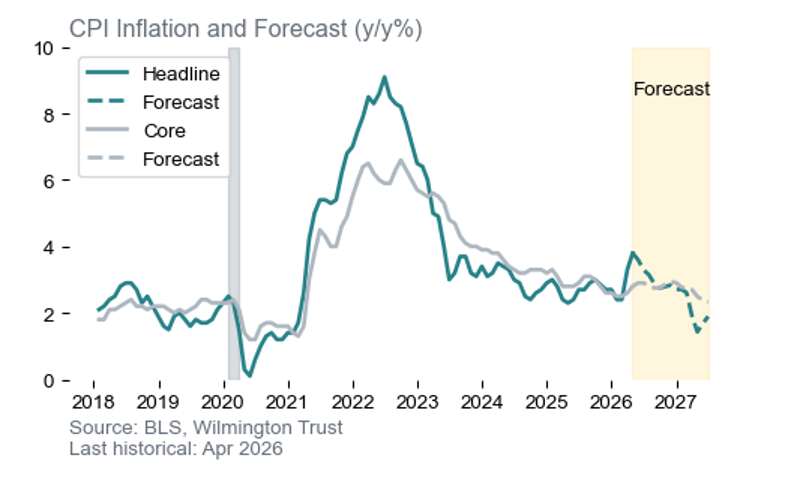
As he assumes the position of Chair, the punch in the mouth has already been delivered. The energy impacts of the Iran War have pushed consumer price index (CPI) inflation to 3.8% year-over-year (y/y) in April, the highest since 2023. That is higher than average wage growth (3.6%), eroding spending power for consumers. That mix makes it challenging to cut rates, illustrated by the fed funds futures market which is pricing in a possible rate hike before the end of 2026.
Additionally, Warsh will take the helm of a committee that has moved increasingly hawkish, with 3 Federal Open Market Committee (FOMC) voters dissenting from the previous official statement because it maintained a bias towards cutting rates as they grew more worried about inflation risk.
We still think the Fed will end up cutting rates in 2026 and early 2027, but not for the productivity reasons proffered by Warsh. We think consumers are in too weak a position to shoulder the hefty gasoline prices without pulling back on other spending. That would limit the spillover into core CPI[3], but also drag on economic growth, warranting lower rates. This is starkly different from the picture Warsh has painted. Importantly, we agree AI will provide a productivity boost for years to come and help keep a lid on inflation, just not as soon as this year.
Figure 1: Energy prices driving inflation but core inflation is the key
Warsh is keen to reduce the Fed’s $6.7 trillion balance sheet, arguing that it is “designed to support the biggest firms in a bygone crisis era” and that the “largesse can be redeployed in the form of lower interest rates to support households and small and medium-sized businesses.”
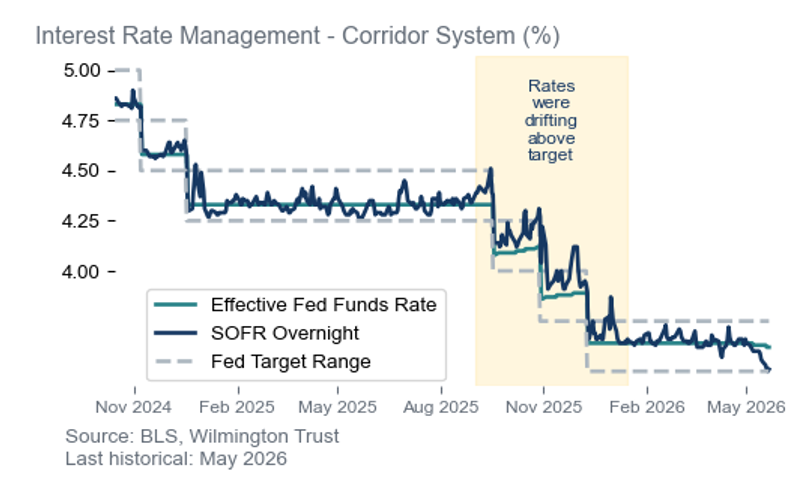
On this score the punch was already delivered in late 2025. At that time the Fed was engaged in steady balance sheet reduction, a process popularly known as “Quantitative Tightening” or “QT.” The challenge with QT is there is a limit to how far the Fed can go. If it reduces the balance sheet too much, there’s not enough liquidity in short-term markets. The Fed doesn’t even know how low it can go until the players in the financial system hold back from overnight lending, liquidity is inadequate, and interest rates shoot higher.
That was the case in October and November of 2025 when overnight rates began to drift outside of the Fed’s target range (Figure 2). The Fed reacted promptly and QT.[4] In the current environment there is no viable way to significantly reduce the Fed’s balance sheet without causing turmoil in short-term markets.
Figure 2: Reducing the balance sheet went too far in late 2025
Warsh could achieve a balance sheet reduction over a longer time frame and indeed framed it that way during his Senate hearing. He said reducing the Fed’s balance sheet could be done “slowly and deliberately.” The critical component of such an action would be to change the demand for bank reserves.
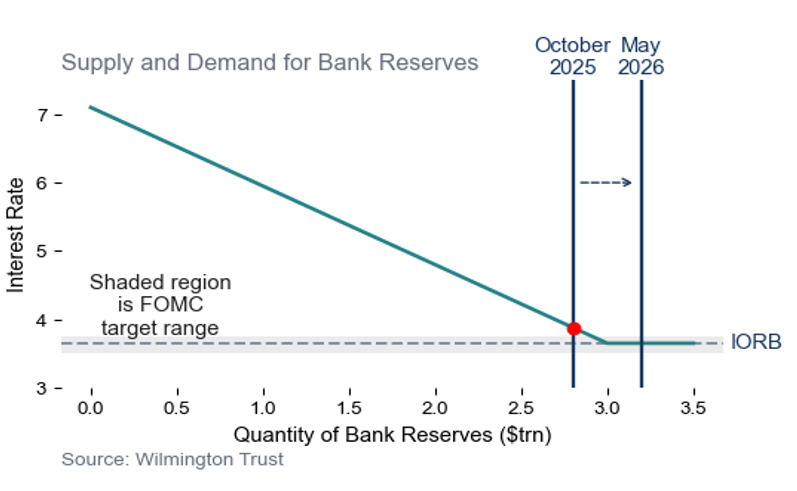
The Fed manages interest rates in an “ample reserves” framework (Figure 3). This essentially means they want to keep just enough reserves in the system such that banks are willing to lend the small excesses to overnight borrowers. Ample reserves are shown as the flat portion of the demand curve. In late-2025 rates drifted out of the Fed’s target zone when the total reserves that banks held at the Fed got down to about $2.8 trillion. Banks were reluctant to lend, and rates started to move up the demand curve. As the Fed added reserves the market has again moved out to the flat portion of the demand curve.
For Warsh to achieve a meaningful balance sheet reduction he would need to reduce banks’ overall demand for reserves. (In graphical form that means shifting the demand curve to the left.) To engineer such a change Congress and the Fed would likely need to revamp asset and liquidity requirements for banks that have been implemented since the global financial crisis. That would be a lengthy, but achievable, process.
Figure 3: Balance sheet expansion was necessary to keep rates in target range
The last main component of Warsh’s planned reform at the Fed is to pull back on the volume of communication. He has suggested possibly changing the frequency of speeches, press conferences and even FOMC meetings. He may find another punch from markets if he moves quickly, as traders have become accustomed to communications.
Warsh’s desire for less communication is not just about frequency, but also about the use of “forward guidance,” when the FOMC officially communicates anticipated future policy moves or Fed officials offer their preferred path individually. Warsh went so far as to say “I don’t believe in forward guidance” at his Senate hearing. His main concern is that Fed officials may commit to a path but then need to change course.
We don’t take a view on whether a reduction in communication is desirable, but we recognize two of the possible impacts: an increase in volatility and the removal of a Fed tool. On the first, a more opaque Fed would leave traders grasping at any information they could find. In the 1990s (before the advent of Fed statements and minutes, let alone press conferences) Fed watchers would try to glean insight from the appearance of Chair Alan Greenspan’s briefcase. A bulging briefcase indicated he was carrying a lot of information and more inclined to raise or lower rates that day.[5] Such opacity could lead to more volatility in markets due to less information.
The second impact is more interesting. The Fed’s increased communication in the past two decades is not just transparency, but has also proven to be a tool at times. The Fed is still dogged by criticism of responding too late to rising inflation in 2021, and not hiking until March of 2022. While the first hike wasn’t until March of 2022, the Fed was using communication to tighten ahead of that official policy move.
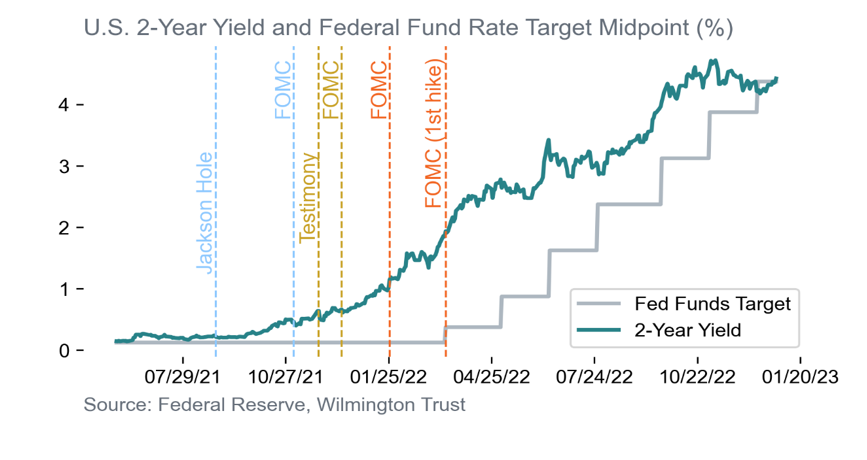
As inflation started rising in mid-2021 the Fed misjudged the price moves as transitory. At the time of Chair Powell’s Jackson Hole speech in August the Fed was still adding to its balance sheet and Powell gave no indication that rate hikes may be on the table, so market interest rates remained low (Figure 4). A month later at the September FOMC press conference Powell said the Fed could be “patient,” pointing to concerns about the labor market. About 15 million people had lost their pandemic-era special unemployment compensation just two weeks earlier and it was unclear whether they would show up as unemployed in the next labor report.
But the labor market did remarkably well and Powell used communication and forward guidance through the fall to increasingly guide markets to expect rate hikes, and the 2-year yield rose from 0.25% in late 2021 to 1.9% on March 15, 2022 when the Fed enacted the first hike. Forward guidance proved to be a valuable tool.
Figure 4: Forward guidance from the Fed is a way to move rates
As Chair Warsh takes the helm of the Federal Reserve there is much speculation that he will quickly implement many of the policies he has spoken about, including lower interest rates, reducing the Fed’s balance sheet, and a sharp pullback of Fed communications. We think the reality is much like the punch in the mouth Tyson warned about, and it will be challenging for Warsh to move quickly.
We do think lower rates are in store for 2026, but more because of slower growth than a sudden productivity boom. Reducing the balance sheet is not feasible right now, but it is possible if preceded by changes to banking regulations.
We remain optimistic yet cautious about the path of the U.S. and global economies, but recognize the risks posed by the Iran War. The buildout of AI infrastructure and the path for related firms are a critical driver of market performance. We maintain a neutral allocation to equities versus our strategic benchmark. We expect leadership to remain with U.S. equities over non-U.S., benefitting from a resumption of tech leadership and strong earnings.
[1] “The Federal Reserve’s Broken Leadership.” The Wall Street Journal. November 16, 2025.
[2] Squawk Box. CNBC. July 17, 2025.
[3] Core CPI excludes food and energy prices.
[4] The only other experience with QT resulted in a more dramatic spike in interest rates in September 2019 when rates surged more dramatically. Since that time the Fed created a backstop tool to prevent such a response.
[5] “Inside the Briefcase: The Art of Predicting the Federal Reserve”. Regional Economist. Federal Reserve Bank of St Louis Fed. July 1, 2000.
Disclosures
Facts and views presented in this report have not been reviewed by, and may not reflect information known to, professionals in other business areas of Wilmington Trust or M&T Bank who may provide or seek to provide financial services to entities referred to in this report. M&T Bank and Wilmington Trust have established information barriers between their various business groups. As a result, M&T Bank and Wilmington Trust do not disclose certain client relationships with, or compensation received from, such entities in their reports.
The information on Wilmington Wire has been obtained from sources believed to be reliable, but its accuracy and completeness are not guaranteed. The opinions, estimates, and projections constitute the judgment of Wilmington Trust and are subject to change without notice. This commentary is for informational purposes only and is not intended as an offer or solicitation for the sale of any financial product or service or a recommendation or determination that any investment strategy is suitable for a specific investor. Investors should seek financial advice regarding the suitability of any investment strategy based on the investor’s objectives, financial situation, and particular needs. Diversification does not ensure a profit or guarantee against a loss. There is no assurance that any investment strategy will succeed.
Past performance cannot guarantee future results. Investing involves risk and you may incur a profit or a loss.
Indexes are not available for direct investment. Investment in a security or strategy designed to replicate the performance of an index will incur expenses such as management fees and transaction costs which will reduce returns.
References to specific securities are not intended and should not be relied upon as the basis for anyone to buy, sell, or hold any security. Holdings and sector allocations may not be representative of the portfolio manager’s current or future investment and are subject to change at any time.
Reference to the company names mentioned in this blog is merely for explaining the market view and should not be construed as investment advice or investment recommendations of those companies. Third party trademarks and brands are the property of their respective owners.
Any investment products discussed in this commentary are not insured by the FDIC or any other governmental agency, are not deposits of or other obligations of or guaranteed by M&T Bank, Wilmington Trust, or any other bank or entity, and are subject to risks, including a possible loss of the principal amount invested.
Some investment products may be available only to certain “qualified investors”—that is, investors who meet certain income and/or investable assets thresholds.
Alternative assets, such as strategies that invest in hedge funds, can present greater risk and are not suitable for all investors.
Stay Informed
Subscribe
Ideas, analysis, and perspectives to help you make your next move with confidence.
What can we help you with today