Equal Housing Lender. © 2026 M&T Bank and its affiliates and subsidiaries. NMLS #381076. M&T Bank Member FDIC.
Institutional Services Insights
Wealth Management Insights
Who We Are
Log In
Select Business Area
Our Services
Institutional Services Insights
The second half of the year is underway, and some of the major themes impacting markets are rhyming with the first quarter. Artificial intelligence (AI) angst is elevated, yet investors appear afraid of missing out on the most transformational technology of our generation. Geopolitical risk has returned to a boil despite the June Memorandum of Understanding between the U.S. and Iran, which had cooled things off. One distinct difference from Q1 is the economic outlook has improved, particularly as the labor market has stabilized and inflation pressures remain muted. Earnings provided a solid underpinning to the equity market.
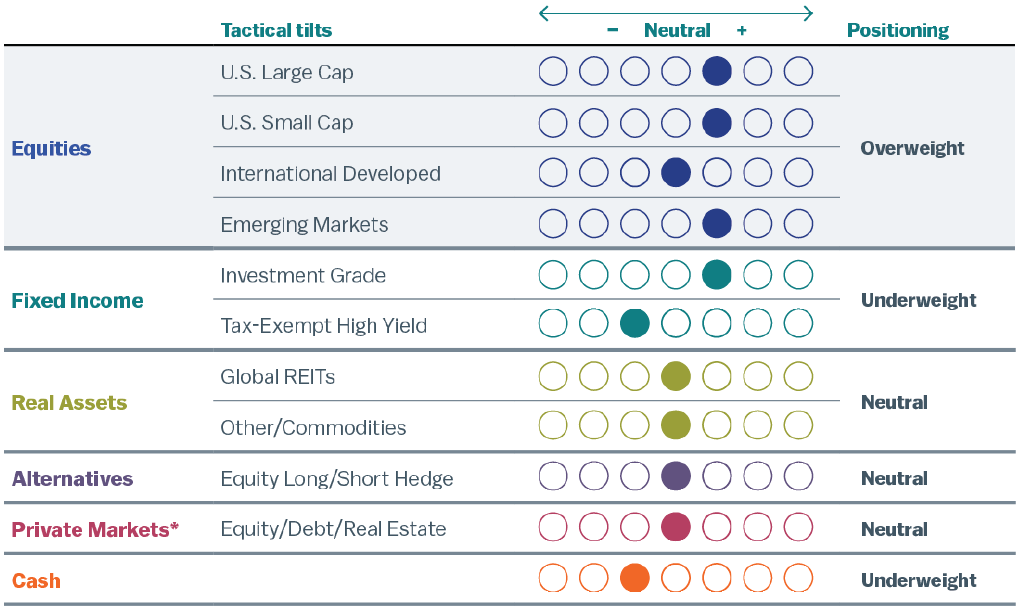
We therefore enter the second half of the year with an overweight to risk in portfolios, having recently added to U.S. large cap, U.S. small cap, and emerging market equities. There could be some near-term volatility in store for the remainder of the summer, particularly after a very strong second quarter for equities, uncertainty surrounding the price of oil, and midterm elections on the horizon. The biggest overhang could come from a prolonged elevation in oil prices, something we had thought was largely behind us at the end of June. However, we are optimistic that these risks will prove manageable and equities will deliver solid returns over our tactical horizon.
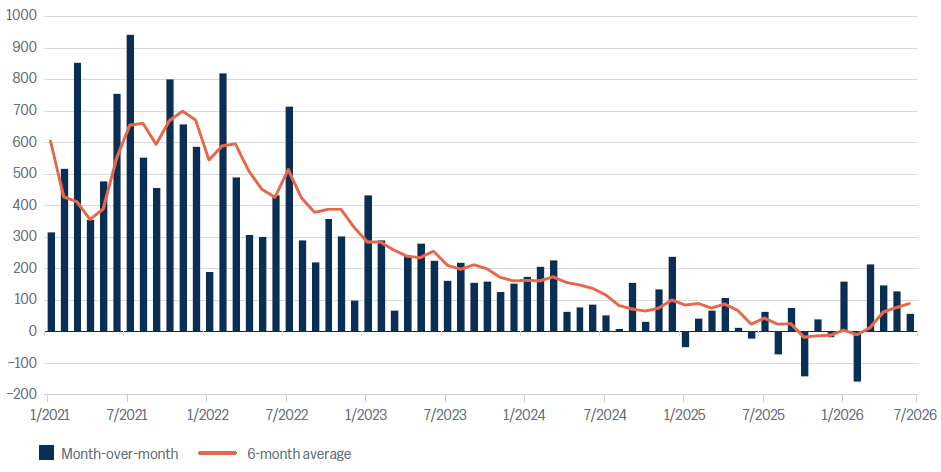
The economic outlook has improved over the past six months. We began the year with U.S. jobs threatening to tip into negative territory. The only source of labor market growth was the always-growing healthcare sector, while the more cyclical employers were in cutting mode, a dynamic we have not historically seen outside of a recession. Yet the economy continued expanding and job growth stabilized (Figure 1). We remain in a low-hire-low-fire environment, but the risk of recession has fallen.
Figure 1: Low-hire-low-fire job market
Job growth (m/m thousands)
Sources: Bureau of Labor Statistics, Wilmington Trust. As of June 2026.
Fading tariff headwinds have helped business activity to improve, across both services and manufacturing, evidenced by ISM surveys in solid expansionary territory, driven by new orders and a quicker pace of production.
But consumer and business confidence remains low. Lower-income households are increasingly pressured by inflation outpacing income growth, leading to a declining savings rate. Non-discretionary items like food and energy are consuming a larger portion of the spending pie. Fortunately, the wealth effect is providing a positive offset, with greater stock market ownership and strong returns supporting household wealth, though that is concentrated in higher-income households.
For markets, the path of inflation remains key and the data continues to support our expectation of abating price pressures into the end of the year. Energy prices are once again on the rise as the war ramps back up. Critically, however, we have yet to see higher energy prices pass through to broader inflation in prices of core goods and services, the focus of the Federal Reserve when setting interest rate policy. The inflationary impact of tariffs is, in our view, largely in the rearview mirror.
We also assess the consumer as more discerning and less accepting of price increases. The last important element of the inflation picture is housing, where sluggish home prices and rents continue to act as a drag on inflation.
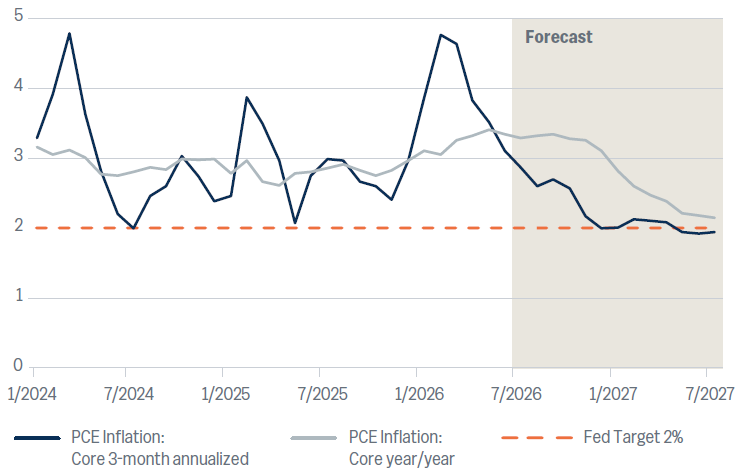
Figure 2: Inflation forecasted to decelerate into 2027
PCE inflation core
Sources: Bureau of Economic Analysis, Wilmington Trust. As of May 2026
Although we expect year-over-year inflation to remain above the Fed’s 2% target well into next year, we have already seen the 3-month annualized rate of core PCE peak
in February 2026 and decelerate sharply despite the energy price spike that started the following month. We expect that dynamic to continue, a crucial element of our expectation that the Fed will not need to raise rates as some have feared. We see the economy as strong enough to avoid recession, but not strong enough to generate inflation. We expect this backdrop to result in two rate cuts from the Fed this year, despite market concerns that the next move could be a hike (Figure 2).
Importantly, if we are wrong about the Fed cutting rates, we think the next most likely outcome is for the Fed to remain on hold because growth is stronger than we expect, not because inflation is rearing its head. This would likely signal the “neutral rate” (the fed funds rate that neither stimulates nor contracts the economy) is higher than previously estimated, which would also be consistent with the recent rise in real interest rates.
In our view, a Fed on hold because growth is stronger and inflation is a bit sticky above their target would prove to be a solid backdrop for equities, which historically have acted as a good hedge against moderate inflation. We will be watching real interest rates and Treasury yields generally, as a 10-year above 5% could usher in more volatility for the equity market.
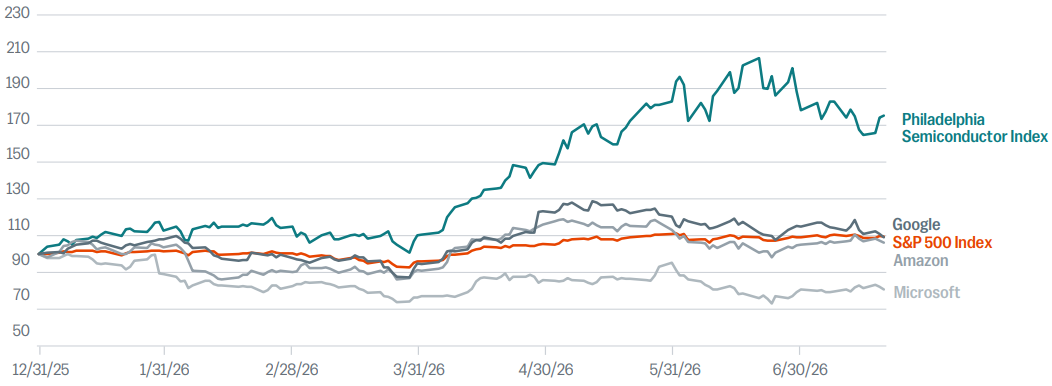
Figure 3: Semiconductors shoot higher in 2Q
Semiconductors, S&P 500, and hyperscalers indexed to 100 on December 31, 2025
Source: Bloomberg. As of July 22, 2026.
Past performance cannot guarantee future results. Indices are not available for direct investment. Investment in a security or strategy designed to replicate the performance of an index will incur expenses such as management fees and transaction costs which will reduce returns.
Earnings growth continues to be the most solid pillar upon which the equity market stands. First quarter earnings were exceptional, though certainly helped by a few outsized reports from select companies. Second quarter earnings for the S&P 500 are shaping up to be similarly impressive at nearly 25% y/y growth, with technology and energy stocks expected to deliver the strongest earnings growth. Banks were the early reporters and noted stable or improving credit conditions, which is a positive sign for the consumer. Overall valuations are above average but not concerning, particularly given record profit margins of 14.8% and our forecast for rate cuts.
The buildout of AI infrastructure is the epicenter of the stock market, and investors are rewarding the companies most benefitting from that spending, especially semiconductors. The Philadelphia Semiconductor Index experienced an 88% return in the second quarter, far outpacing the S&P 500 (Figure 3), as AI-related demand is generating a memory chip shortage. Since then, high-momentum stocks including semiconductors have come under pressure. There are also re-emerging threats of cheaper, better models coming out of China—not all that different from the “DeepSeek” threat that sent tech stocks reeling in January 2025.
The potential for AI models to be developed with fewer or less sophisticated chips threatens hyperscalers (a select group of large companies like Microsoft, Amazon, and Google that provide cloud and data center services). Their spending spree has come under scrutiny given continuous upward revisions to investment plans and an increasing need to tap capital markets rather than source from cash on balance sheets. These companies are still producing solid earnings but lower returns on free cash flow. The hyperscalers may present attractive value at today’s levels if they can increase the monetization of their investments.
One nuance to the markets is that the AI investment theme can drive performance in unexpected places. In the second quarter, for example, the Russell 1000 Value index benefited greatly from the sharp outperformance of semiconductor names. These are companies that are more often associated with growth rather than value investing. The Russell 1000 Value had roughly a 3.5% weight to Micron Technology (the largest weight in the index), which was a major beneficiary of the AI-driven semiconductor rally, posting a 242% return in 2Q. In late June, the Russell index was reconstituted, or rebalanced, based on the value and growth characteristics of individual stocks, which resulted in Micron and several other semiconductor names, including AMD, moving from the Russell 1000 Value Index to the Russell 1000 Growth Index. It could very well be the case that memory chip companies rode the elevator up in the value index and will continue their ride (or potentially ride it down) in the growth index—a dynamic that is critical for how we think about constructing portfolios and assessing active managers.
Despite a strong run for the market in the second quarter, it is a compelling time to add to equities, in our view. We recently added to U.S. large cap, U.S. small cap, and emerging market equities in client portfolios, funded from investment-grade fixed income and cash.
An economy that is not too hot to produce inflation, but strong enough to avoid recession, should allow the Fed to cut rates, which would support valuations for U.S. large cap and small cap. We expect small cap to be one of the strongest asset classes if the market moves to our view of Fed rate cuts because of their higher leverage, and valuations are still attractive relative to large cap.
Emerging market equities have been the best-performing asset class over the trailing 12 months and year-to-date. Yet the price-to-earnings multiple on the MSCI Emerging Market Index has declined over that period. Earnings growth has been incredibly strong, and we find the asset class’s exposure to emerging economic growth and AI investment opportunities attractive. In addition, emerging market equities tend to exhibit a negative correlation with the U.S. dollar. We would expect the dollar to weaken (and emerging market equities to gain) if the Fed cuts rates.
The addition to risk was funded from fixed income and cash, which we would expect to underperform equities in our base case. Credit spreads remain historically tight, and we hold less relative exposure to high yield because we do not see investors being compensated for the additional credit risk at current valuations.
The main risks to our outlook stem from geopolitics. First, the U.S.-Iran War is rearing its head again, despite a Memorandum of Understanding in June. Unfortunately, that geopolitical risk is being transmitted through higher oil prices. Fortunately, we are not seeing oil prices at a level that materially elevates recession risk, nor do we see evidence of energy prices bleeding into other areas of inflation. The U.S. is relatively better off than other developed economies when it comes to the risk of higher energy prices. Within emerging markets, China has been making use of its massive stockpile of oil reserves. The U.S. and emerging market equity indices have also been buffered by strength in technology stocks, thereby deflecting some of the downside impacts of geopolitical risk for investors.
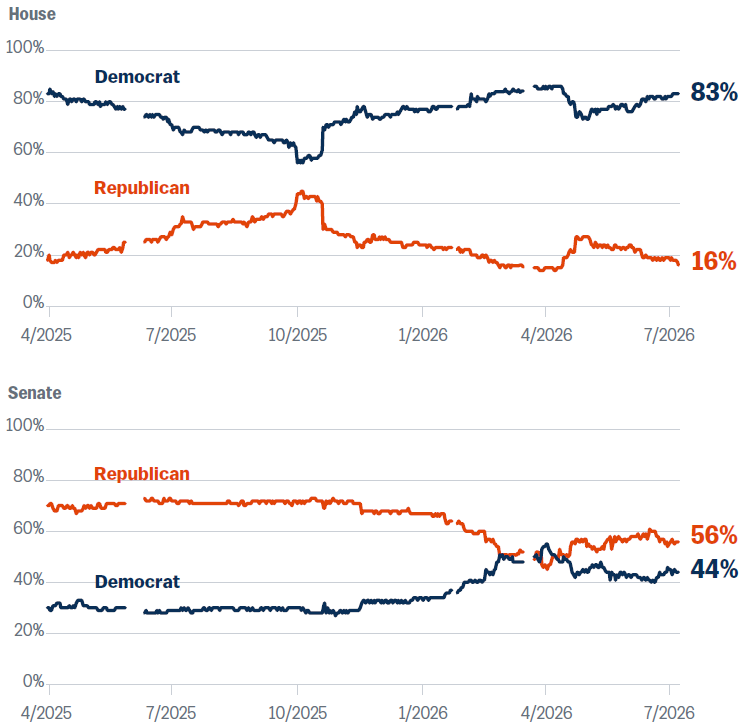
Figure 4: Republicans projected to lose House, keep Senate
Control of Congress (% chance)
Sources: Bloomberg, Kalshi, Wilmington Trust As of July 22, 2026.
The U.S. is approaching a midterm election, which can historically introduce more volatility to the markets, though in this case it could provide a helpful deadline for meaningful resolution to the U.S.-Iran conflict. Per historical precedent, the incumbent party is expected to lose seats in both the House and Senate (Figure 4). This would likely result in gridlock, which is a scenario generally favored by markets due to the reduced chance of disruptive policy changes being passed in Washington, though this could come with considerably more political brinksmanship and “noise.”
Figure 5: Asset class positioning
High-net-worth portfolios with private markets*
Data as of June 30, 2026.
Positioning reflects our monthly tactical asset allocation (TAA) versus the long-term strategic asset allocation (SAA) benchmark.
For an overview of our asset allocation strategies, please see the disclosures.
*Private markets are only available to investors that meet Securities and Exchange Commission standards and are qualified and accredited.
We recommend a strategic allocation to private markets we do not tactically adjust this asset class.
Worth monitoring in the lead up to the midterms is the politicization of AI, which could interrupt the build out or adoption of this powerful technology. Issues of inflation, job losses, and increased energy costs from AI could be leveraged to obtain votes, which could negatively impact investor sentiment toward AI-related companies.
The landscape is complex, and we are reminded that if one is waiting for the “all clear,” they will likely be sitting on the sidelines forever. While risks need to be carefully considered as part of the investment process, we see the balance tipping in favor of an expanding economy and solid returns from equities in and beyond the second half of the year.
Please complete the form below and one of our advisors will reach out to you.
* Indicates a required field.
Stay Informed
Subscribe
Ideas, analysis, and perspectives to help you make your next move with confidence.
What can we help you with today